
I am enamored with flowers; so it has been, and so it ever will be.

In the house of my earliest memories, my father grew huge hydrangea flowers in the center of our circle driveway. The flower heads were comprised of hundreds of florets emerging from the center; each flower head was bigger than my own.
Someone took a “super 8” silent movie of my sister and me, running in our white dresses around the bushes, barefoot and laughing. We slowed when we reached the crumbled-stone driveway, and then picked up speed back on the grass, racing along with our little dog.
My real memory of the moment has been replaced by the movie, and now I “remember” seeing my sister and me running, running, running around the white flowers, until my sister collapses in the grass, gasping for breath. I slow, pausing to bend over one of the huge flowers, my long hair falling over my face to create a private space where I can enjoy the perfume.
Falling in love
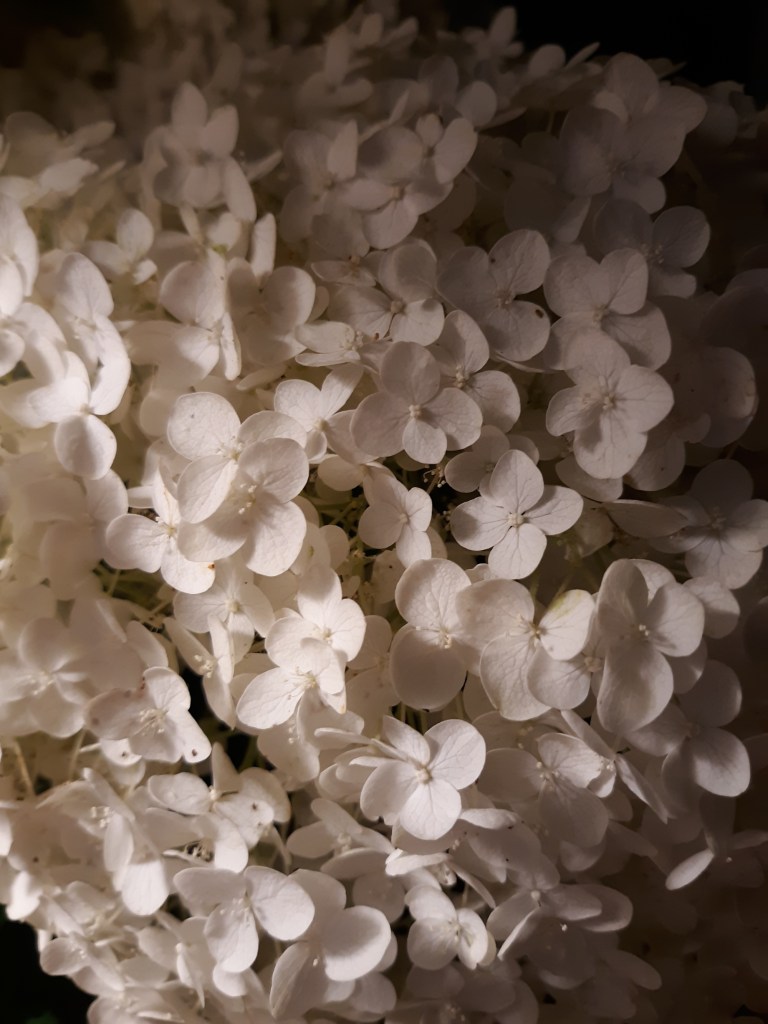
The movie pauses while I bend over the flower, and in the background my sister rolls over and sits up in the grass. An attention-seeking friend runs into the frame, but the camera stays on me while I breathe in the fragrance, oblivious to everything else.
I may not have a good memory of that exact moment, but I know it well. It is a love-struck feeling: An arrest at the sight of the flower, an intake of breath, and then a moving forward to see more, to touch the petals, to inhale the fragrance.
Ah, flowers! Jesus, Himself, through whom our whole world was made, drew his disciples’ attention to the flowers to illustrate our Heavenly Father’s constant care for his children. (Matthew 6: 28 – 30) He said, “. . .even Solomon in all his glory was not arrayed like one of these.”
Does attention produce beauty?
When we started homeschooling so many years ago, part of our equipment was a really good camera with the best optical zoom we could afford. So much happens at the macro level, and seeing things close-up has been quite an education. I began to see that the thing we call “beauty” has more to do with our focus on it than with a quality that thing possesses. The more attention I paid to a flower, for example, the more I appreciated it. It was as if the more time my eyes were on it, the more beautiful it became. I found parts of it I hadn’t seen before. (I have found the same thing to be true of people to whom I pay closer attention.)
This may seem like a subjective experience, but maybe not; we know through experiments that microscopic elements change when human eyes watch them. Light for example, exists as both a particle and a wave. Human observation can cause light to change its expression from that of a particle to a wave or vice versa. Quarks, those tiny parts inside the nucleus of an atom, change their “flavor” when viewed through an electron microscope. Why is it so far-fetched to think that a flower (or a person) becomes more beautiful when we pay attention? Is it possible that this is another shade of meaning behind the adage, “Beauty is in the eye of the beholder?”
But that brings up another thought: Maybe when a person criticizes another for lack of beauty, the comment says more about the state of the speaker’s focus than anything else.
A reason to pay attention
A decade ago, I decided to grow cosmos flowers. My father told me that his mother grew them every year. She has passed on now, and since I didn’t know her well, I figured that spending time growing her favorite flower would help me understand her.
The cosmos first surprised me with delicate, needle-thin foliage, and then astonished me with six-foot height! The flowers began to appear as daisy-like (white, pink and wine-colored) floating above thin stems.
One day while I was in the garden at full noon, I realized that every stage of the flower, from tiny bud to full bloom, was present on the plant. I grabbed the moment with my camera, taking photos of the bud-just-ready-to-open. I noticed that the sepals were translucent, and through them, I could see the folded petals. The opening bud appeared to explode more than anything else, with the pressure of the developing petal forcing the sepal back. That single petal spilled out onto the “stage floor” that the rest of the unopened bud created, like a ballet dancer anticipating her cue just a moment too soon, standing in the spotlight all alone.
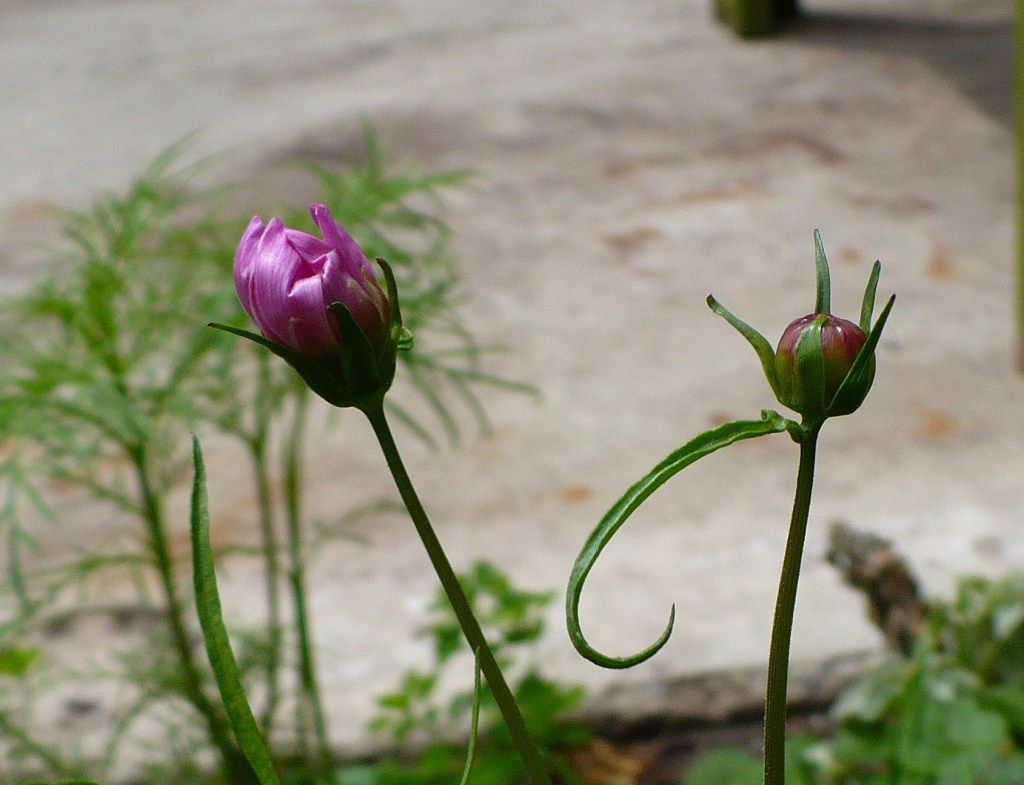
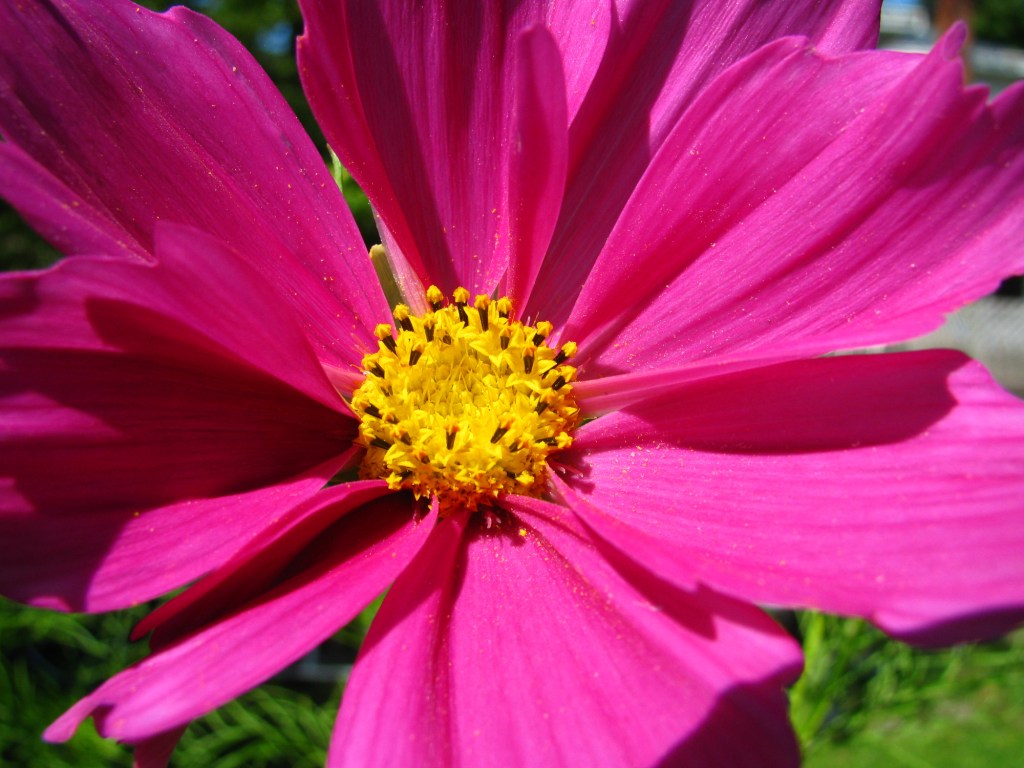
The new fully-opened cosmos flower has a smooth center, velvety and soft, made of spiraling rows of anthers waiting to mature and emerge. In another, more-mature flower, a ring of those anthers emerged around the perimeter of the center, each anther like a tiny five-pointed star with a filament tail. The little cylinder the anther emerged from then emerged about half as far, like a tiny star-shaped flower. No wonder they named this plant “Cosmos!”
A birthday indulgence
For my birthday last year, my sons took me out on an “exploratory drive” and we wandered the back roads, collecting wildflowers. I was amazed at the wonderful variety we found in one day, all in bloom at the same time! When we got back home, I had fun arranging them into every vase-shaped container I could find. I know, my skill in arranging flowers leaves much to be desired, but I still just love the flowers!
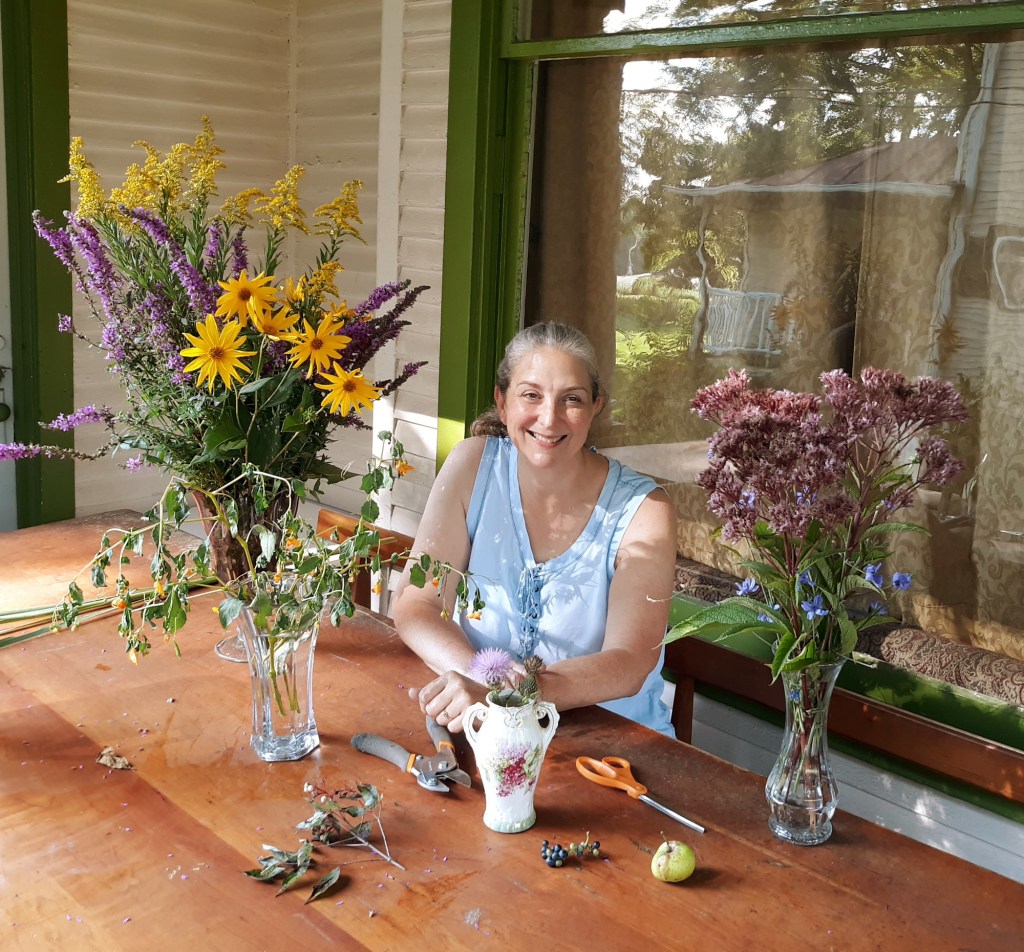
My favorite birthday flower from that year was the amazing jewel weed. Each orange flower dangled, like a little earring, and the stems emerge alternately in a spiral so that each dangling flower had freedom to move. The individual flowers were shaped like tiny horns-o’-plenty with a curled tail. But they wilted astonishingly fast. The jewel weed was the last flower we collected, and by the time we had traveled the five minutes back home, it was completely gone, so crumpled that I wasn’t able to even get a good picture.
Ah well, I will hold onto the memory of how it looked for a long time; I may never find another just like it. And then again, I just may!
 The Fullers Four