
Did you ever wonder how our common dandelion got its name? I love to look at words and see how they came to be. You can look such things up easily enough now-a-days, but sometimes I like to double-check what I am told via digital methods with an actual paper-and-chipboard book.
In this case, the book in question is the 1828 American Dictionary of the English Language by Noah Webster. It’s a wonderful resource for the historical perspective on an English word, and shows what our ancestors were thinking when they said the same word we are still saying now, nearly 200 years later.
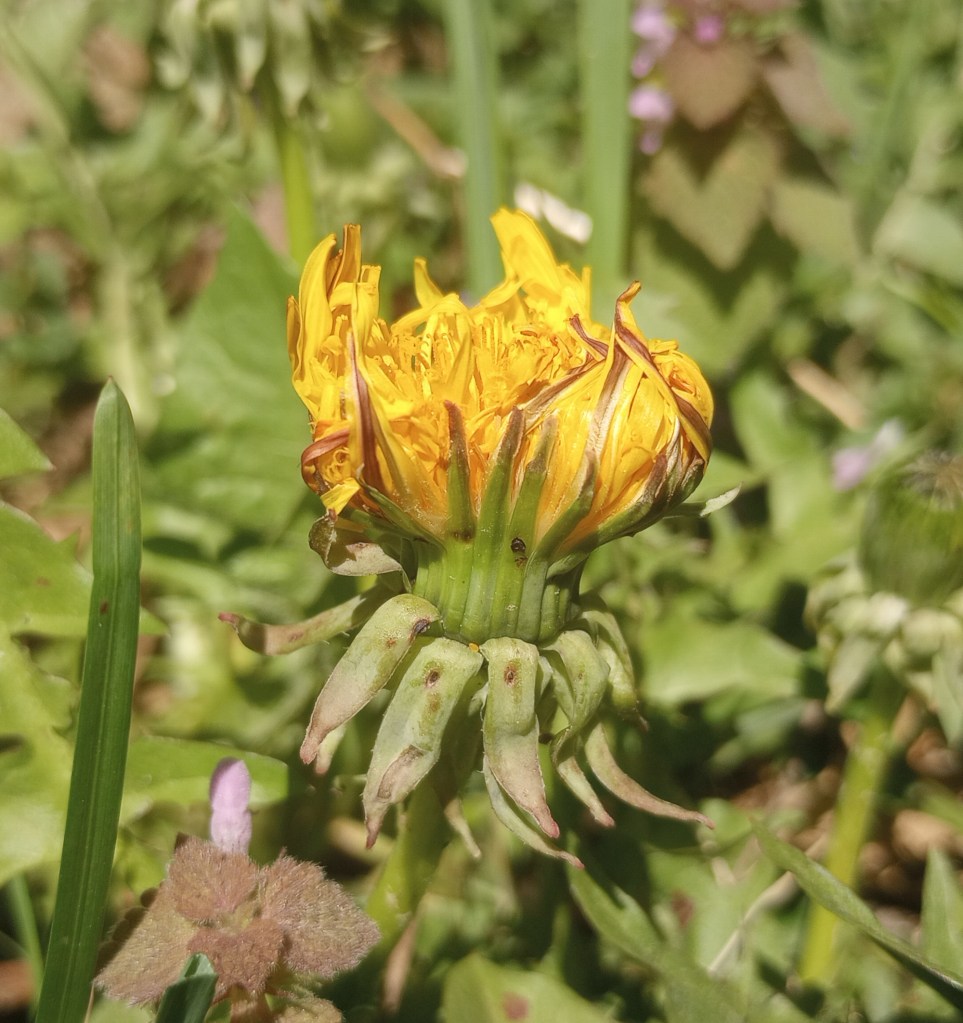
I was a little disappointed to find that our physical-copy definition of the word “dandelion” matches what is online. In short, the word comes from the French language, “dent de Lion” or “tooth of lion.” Why a lion’s tooth instead of, say, a rat’s tooth, which is more needle-like and is often yellow? Maybe it’s because the yellow shaggy petals resemble a lion’s mane; but anyway, who wants to name a flower something like “rat’s tooth”?
Edit: Upon further, more careful reading, I noticed the reason for the “lion’s tooth” name is because of the shape of the leaves, not the petals. Makes perfect sense, of course. (Blush!)
And the dandelion is a powerhouse of nutrition, supporting reproductive and digestive health, and is completely edible, both the parts above and below ground. In fact, when coffee was hard to get during the second world war, Americans drank roasted dandelion root tea instead (aka “dandelion coffee”.) And if you try it brewed strong with a little cream, you might find you like it better!
I guess it is a good thing to have consistency between online and print definitions, especially for those who want to live in the Land of Grammatic Perfection, but I am always hoping for a little nugget of information that has been lost in the translation. After all, language is a living thing that changes as our culture changes. And that change is exactly what makes the study of the history of a word so enchanting to me.
(The “Land of Grammatic Perfection” has a nice ring, doesn’t it? I am picturing an illustration from an imaginary children’s book: A papery landscape, populated by giant stacks of books and letters, featuring streams of sentences which cascade across the land, while puffy punctuation marks float in the sky in place of clouds. )
Ahem! Where was I?
Right! So the reason I brought all this up about the definition of “dandelion” is because it is currently the time to “gather ye dandelions while ye may.” Oops, I guess Robert Herrick was referring to rosebuds, but the idea remains the same: Carpe Diem! Seize the day!
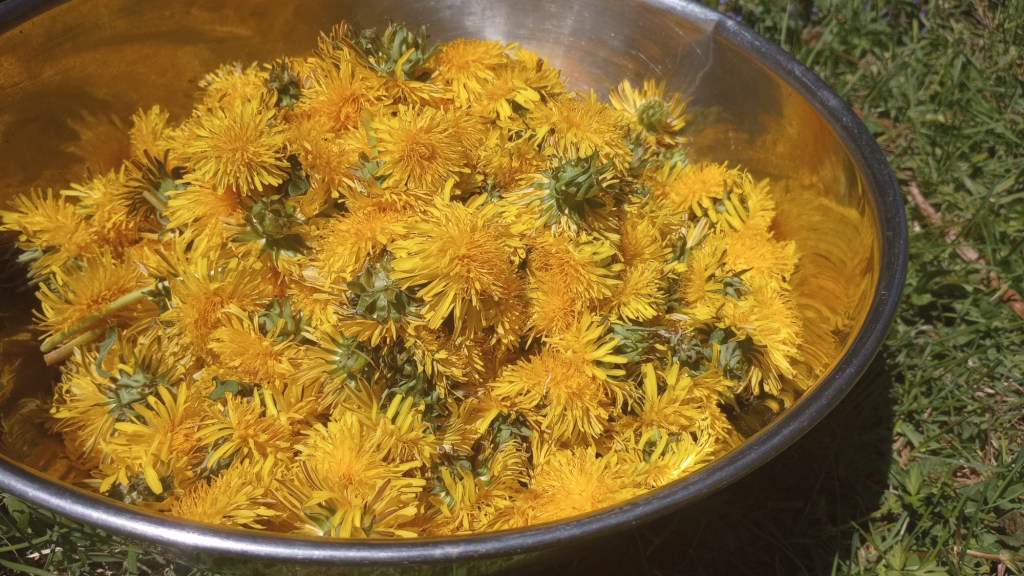
Or in this case, “Seize the Dandelion!” Yes, once again we are foraging for the super-nutritious, tasty-delicious dandelion blooms, in order to make jelly and wine.


See? I used the word “nary.” Once I get started in the old books, I’m rather lost, but in a good way. So one other note from the old dictionary before I quit: As I looked over the page where the “dandelion” entry was found, I discovered the following entry for the word, “Dandy.”
“DANDY n., [Qu. Scot. Dandie. See Dandiprat.]
In Modern Usage, a male of the human species, who dresses himself like a doll, and carries his character on his back.”
Considering this definition was written in 1828, one may imagine this particular word expressed distaste. On second thought, considering the way men wore wigs, high heels, and stockings under their short pants back then, perhaps the word was simply descriptive.
However, good character does not depend upon the clothes on your back (and never has). Rather, it is something we earn through self-restraint. loyalty, and responsibility. It paves the way before us and precedes our arrival when we go someplace new.
“A good name is rather to be chosen than great riches, and loving favor rather than silver and gold.” (Proverbs 22:1)
Loving the Lord Jesus Christ leads naturally to good character because we cannot bear to hurt or disrespect him. He tells us that if we love him, we must love our neighbor. And if we are cold or cruel, that is evidence that the love of the Father is not in us. When he changes our hearts from stone to flesh, the “fruits of the Spirit” naturally flow from our life. Those include love, joy, peace, patience, gentleness, goodness, faith, moderation–in other words, good character! (Galatians 5:22-23)
I did a little more digging in the Online Etymology Dictionary and found that the female counterpart to the “dandy” is the “dandizette” (from an 1821 reference–virtually identical meaning.) And the “dandiprat” referred to above in the “Dandy” entry is “a little fellow, an urchin.” A note from Samuel Johnson has been included that dandiprat “is a word of fondness or contempt.”
Take your pick, depending upon the subject, I guess!
The above may be far more than you ever wanted to know about the meaning of the word “dandelion,” or the associated definitions on the same page, so I will leave it at that for today. Besides, there are more dandelions popping up out there as I write!
If you are interested in learning more about our adventures in dandelion jelly-making (or “dandelion honey”, as it is called), you can check out our post from two years ago. I included our jelly recipe and instructions for making some for yourself. I also posted a lovely poem by my Grandma Dode which may prompt you to look at the “yellow on the green” with new eyes.

Have a beautiful day, whether you classify yourself as a “dandy,” “a dandiprat,” a “dandizette”, or just as your wonderful self. You are treasured and loved more than you know by our heavenly Father, and by those who love him, too!
 The Fullers Four