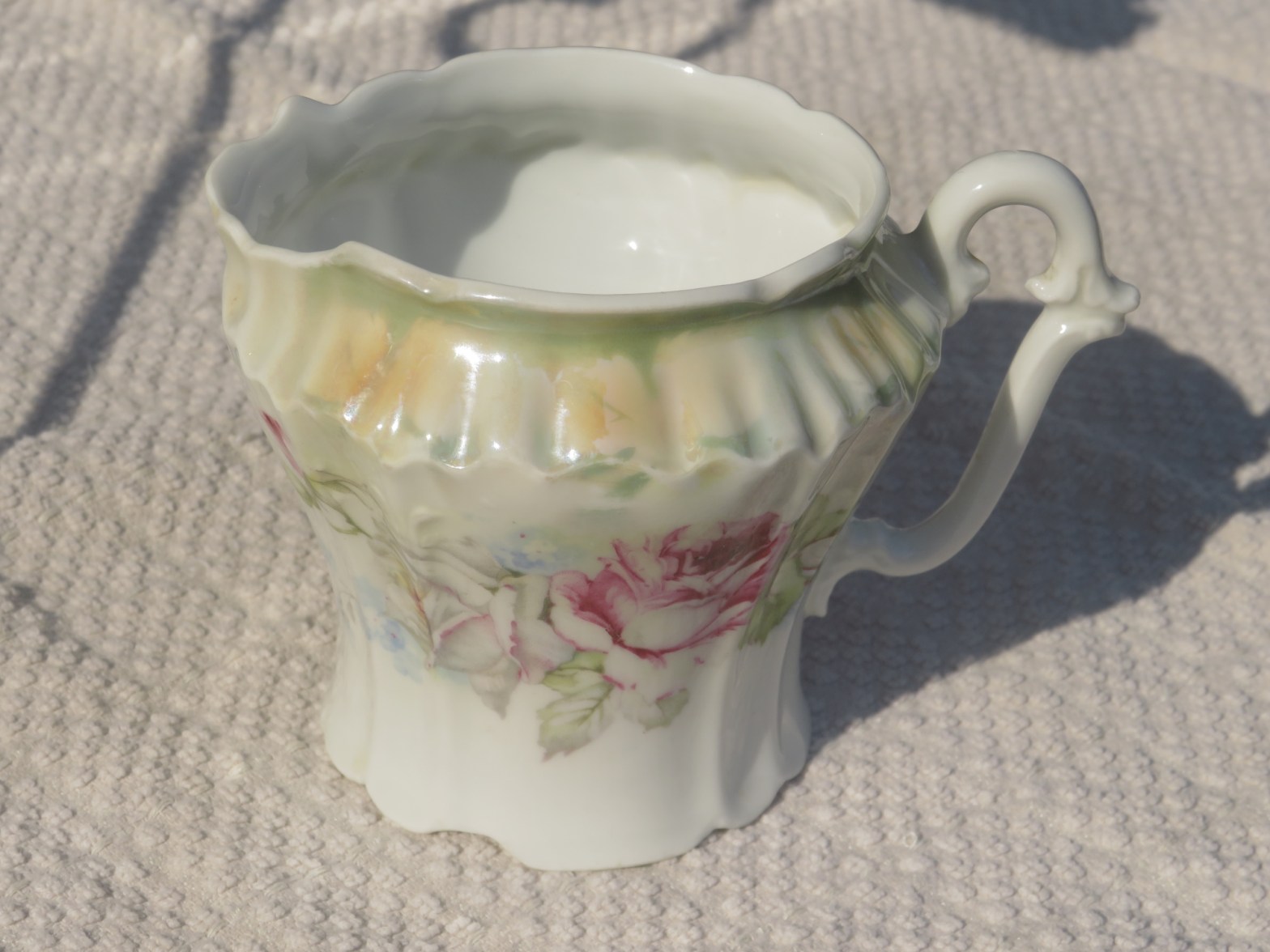
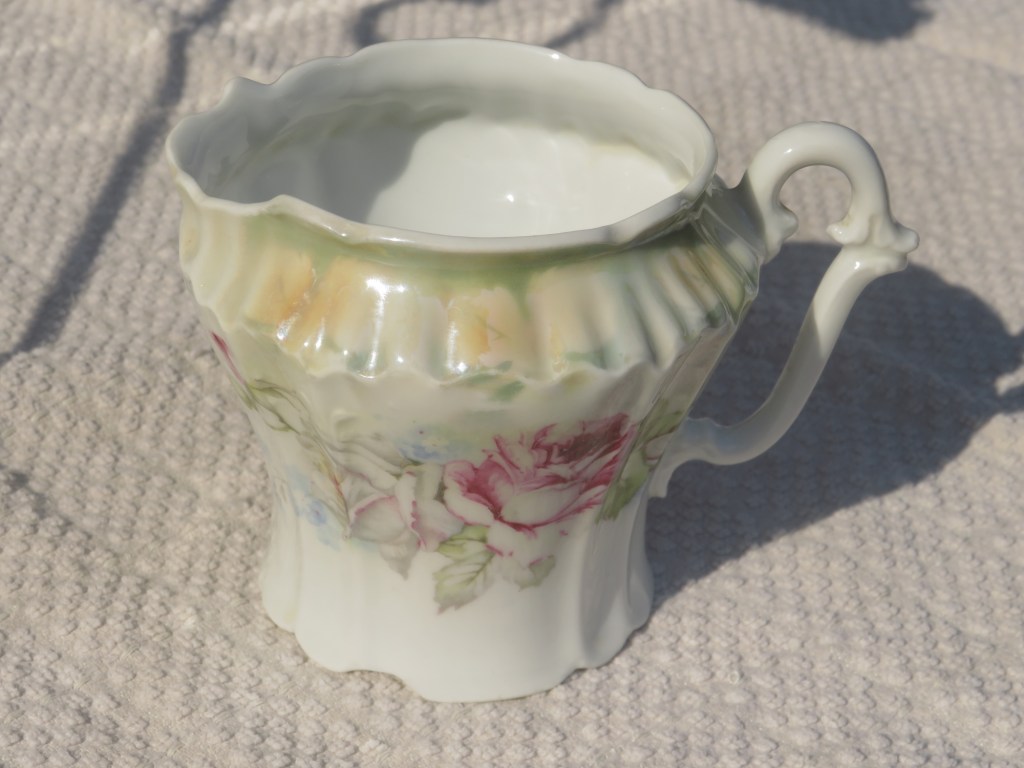
I was cleaning up in the studio today, and I came across a thrift store find from a few months ago; it was a little cream pitcher that had a small chip in the base. Right after I brought it home, I accidentally dropped it, and the lip of the pitcher broke off.
I saw that it still had use as a vessel (I am like that), and I set it aside to evaluate it for a possible repair. (That’s why it was in the studio instead of with the dishes!)
I began to clean it up, and as I was drying out the inside, my hand grazed the edge of the broken spout, and I got a cut. After I bandaged the cut, I checked the pitcher over for any other sharp spots that I needed to fix and found several.
I got to work, smoothing the chipped areas with my rotary tool. Porcelain is harder than I thought, so it took me a little while, but soon the sharp edges were gone, and I began to wonder if the spout would actually pour or not. I continued to work with the lip, sanding the edges smooth, and began to notice things about the little pitcher.
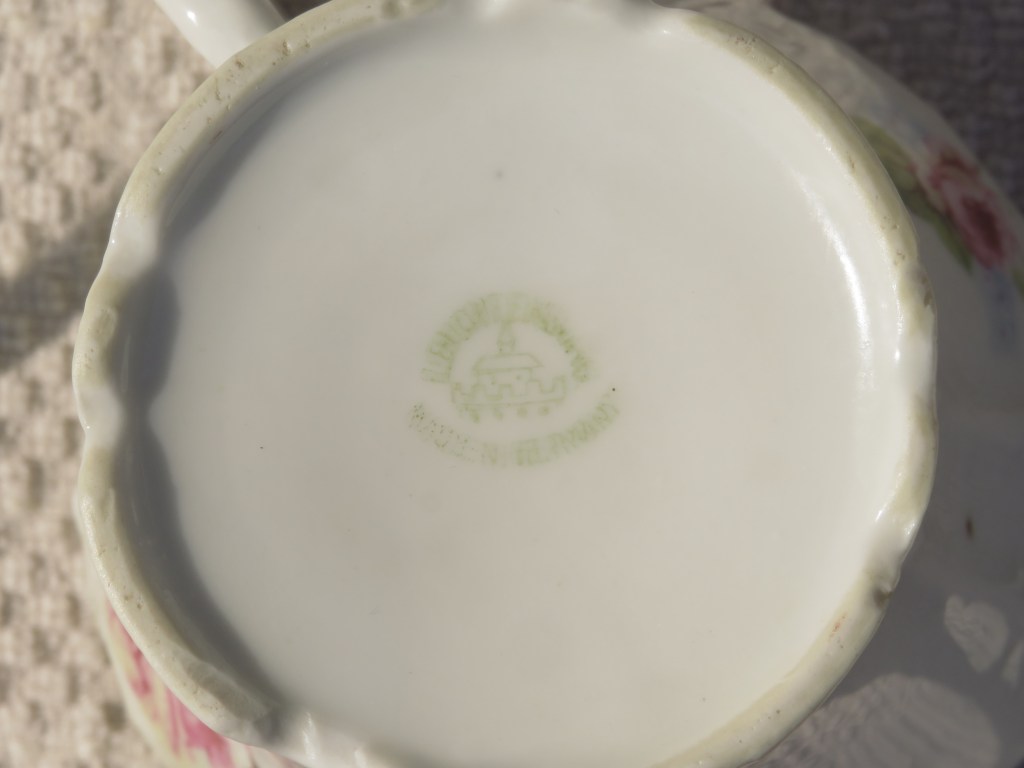
The maker’s mark on the bottom was smeared, though the icon was clear, and the words were almost unreadable. I could make out that it was made in Germany, and it might say “Lichtenburg” on the top of the mark. I guessed from the style that it was produced in the late 1800’s, and I could see from the marks on the bottom that it had been used quite a bit. As the case so often is, the more I paid attention to the little thing, the more I liked it.
I find the same thing is true of people that I draw! I notice those little details, the quirky corner of the mouth, or the exact pattern of wrinkles at the edge of the eye, or the way one eye is larger than the other, etc., and soon I feel so close to the subject.
Faces are so revealing. Maybe the intimacy of the attention removes some kind of psychological barrier or something, but I find that I like people much better after I draw them.
So as I was thinking about how attentiveness makes both people and objects more attractive, I began to recognize that we are all broken, and some of us are in desperate need of repair. We have all been betrayed by someone we love, or had our hearts broken in one way or another.
As we go on with our lives, still partly functional (or as we like to pretend, totally fine in every way!), the sharp edges of the break remain. When we get close to others, those sharp edges can hurt our friends the same way the little cream pitcher cut my hand while I was trying to clean it up.

Just as I smoothed the sharp edges so that I wouldn’t cut myself every time I used the little pitcher (when I put my hand inside to wash it, for example), we do well to let our friends know when they hurt us so that they don’t keep doing it.
Jesus tells us to let someone know when they hurt us, so that they have the opportunity to make things right. It takes humility to admit we hurt, because it shows we are vulnerable (as of course we are!), but hiding our hurt can hurt or kill the relationship. And if our friend has sinned against us, then he or she has also sinned against God, and it will hurt their soul not to turn from that sin. If you think of it that way, letting them know (lovingly!) that they have offended is an act of mercy.
While we are obviously invested in how things turn out with a friend, we are not responsible for how they respond. Sometimes your friend will push back and defend himself or he might even attack you. But try to keep in mind that the goal is reconciliation, not forcing him to change. (After all, God doesn’t force us to do anything.)
If your friend refuses to back down, you may have to reset some boundaries while he figures things out, but don’t get frustrated and give up on the relationship. Friends are precious–the one thing you get to keep after this life is over.
Put it into perspective by imagining what it would feel like if you were in your friend’s shoes. What could you say to make things easier for him to reconcile with you? Treat him the same way you would want to be treated, because that is the way we please God. Loving God and keeping the “Golden Rule” is actually “the sum of the law and the prohets” according to Jesus. (Matthew 22:36 – 40)
Proverbs 27:17 says : “As iron sharpeneth iron, so a man sharpens the countenance of his friend.” We rise to our best selves when we interact with a friend whom we respect, someone who challenges us. The idea here is that two substances of the same hardness will wear away any burrs or scars without causing more problems. But if your friend doesn’t listen to you, don’t give up! Try another way.
Another proverb says, “A soft answer turneth away wrath, but grievous words stir up anger.” (Proverbs 15:1) This is the flip side of the sharpening aspect of friendship. When we are sweet to each other, steadily reacting in kindness and selflessness, we help smooth away those sharp edges. It is very difficult to remain grumpy when the other person shows consistent compassion and tenderness.
As we interact in healthy, loving relationships with each other, our broken, sharp pieces become smoother and smoother and soon we understand that good friends bring healing to our broken places. And the healing ultimately comes from the compassion of Jesus, because he lives in our hearts, giving us the power to react kindly to criticism or whatever the abrasiveness is. He helps us do the right thing at the right time. That is his righteousness living through us.
The little cream pitcher isn’t worth anything, except to me, and I often wonder if I’m not just wasting my time in trying to repair these little worthless things. But I know that just because something is broken doesn’t make it worthless.
The act of repairing something that is valuable simply because I happen to like it is a way of copying our Creator. It is the same thing that Jesus is doing for the world. We are valuable because he loves us. And He loves us too much to leave us broken. He says, “I am making all things new.” Revelations 21:5
We have all been broken, but the Creator of the world took pity on us. And it’s a good thing he did! No one else has the power to remake us into what were were always meant to be except the One who created us in the first place.
While we often just smooth a rough edge or replace a part on a physical thing we are repairing, we don’t have the ability to heal a person like God does. We just forgive and let God do the healing work in both of us. He has the ability to make a full repair, not just a cosmetic one.
He waits to soften and repair our hearts and renew our minds. And all he asks of us is that we believe in the Lord Jesus Christ and what he has done for us.
Every time we pull something up off the ground, dust it off and decide that it still has worth (when repaired), we are redeeming that thing in a similar fashion to the way Jesus redeemed us. We are giving our time (which is really a piece of our lives) to bring it back to use so that it can belong again, so that it has a purpose.
Maybe it’s a physical thing or maybe it’s a relationship; whatever God puts on your heart to repair, do it with all your might! Maybe he is teaching you, through your repair work, something worth knowing about yourself and your place in the world.
Pastor Keith Porter, our former pastor, often used to say, “Please be patient, God isn’t finished with me yet.” And He isn’t finished with me, or you, or this world yet. He is making all things new.
And I, for one, can’t wait for the makeover! Have a blessed day!
“A new commandment I give unto you, that ye love one another; as I have loved you, that you also love one another. By this all will know that you are my disciples, if you have love for one another.” (John 13:34-35)
 The Fullers Four