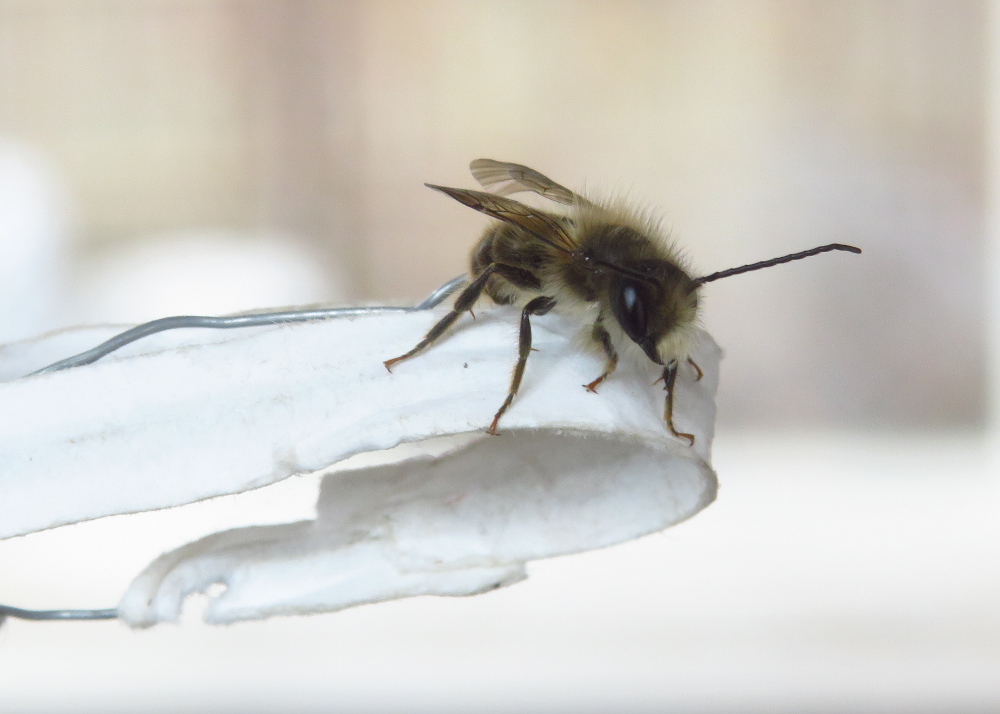
It all started with a plumbing leak, which led to rearranging some things in the basement. The guys fixed the leak, but while they were doing that, I started sorting through boxes. But when we decided to bring some boxes upstairs to sort them, that is when the fun began.
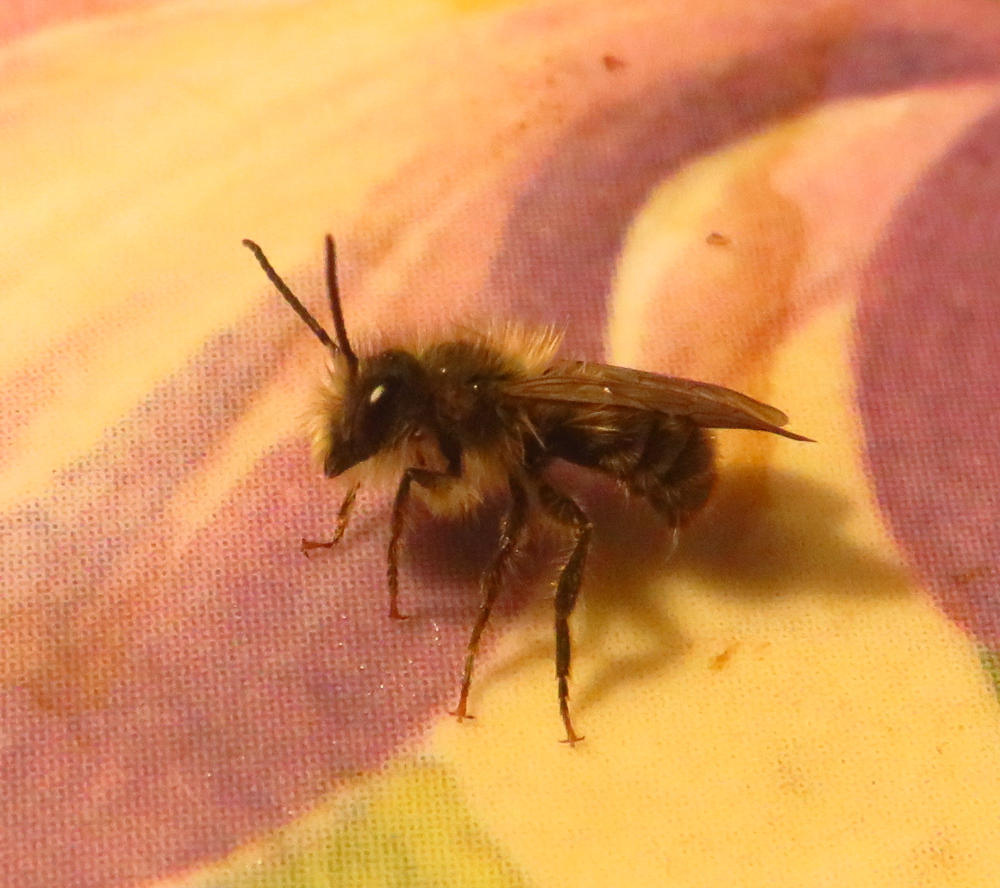
While we were moving boxes upstairs, Tony found three small bees on a chair. They were super tiny, much smaller than honeybees. (For perspective, the bee in the first picture is resting on a twist tie.) There was no way they had been there earlier in the day. And they were groggy. Tony thought they had just woken up from hibernation.
Tony knew they needed help to survive. For one thing, they were cold. For another, they needed food and water, but wouldn’t find their natural sources in our house.
My main question was, where in the world did they come from?
We looked them up on bugguide, and believe they are some kind of solitary, ground-nesting bees. They dig in the earth to nest and lay eggs, and they use nectar as a food source. And in their adult form, they live very short lives. So it’s not likely they could survive long indoors. They must have come from outside, or from in the basement. (Michigan basement, dirt floor.)
We love most insects, and usually try to relocate them to where they should be. But our weather has had lows in the 20’s for the past couple of nights, so we feared that putting the tiny bees outside in their just-emerged condition would have killed them for sure.
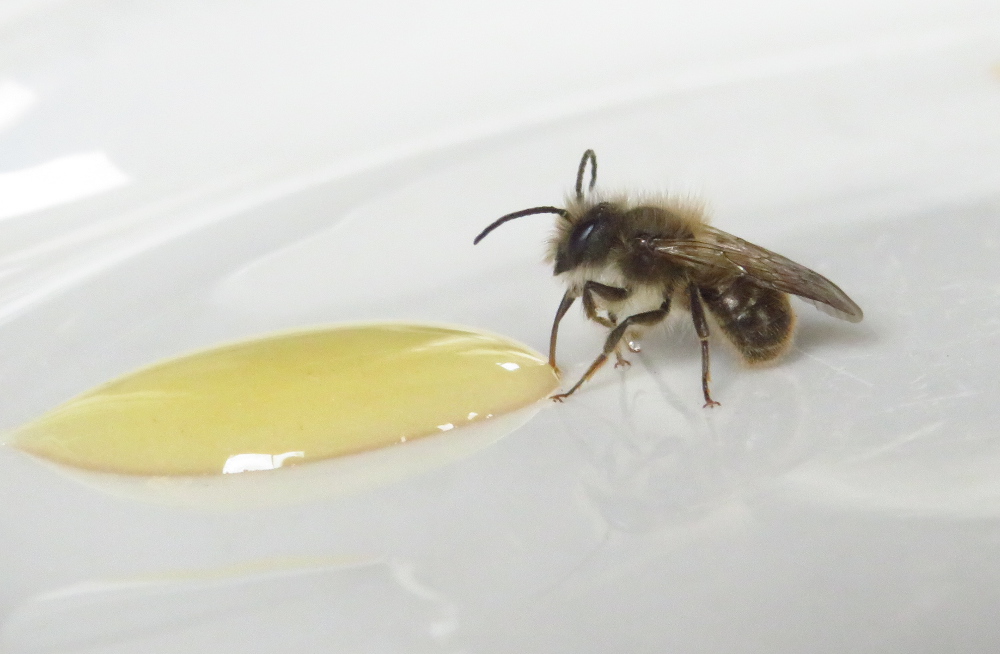
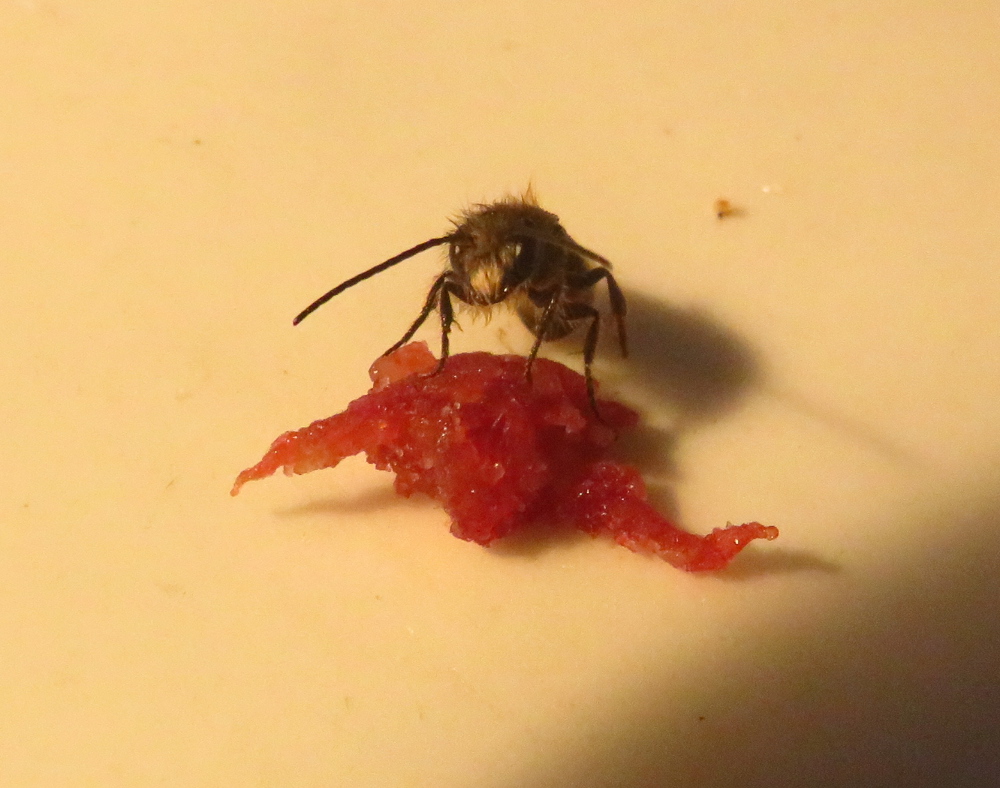
Tony gathered the homeless bees onto a plate because they were still too weak to fly. He put a couple drops of water, a small bit of raw meat, and one big drop of honey on there with them. The warmth helped, and they were able to move to the food and water as they desired, and they ate and drank their fill. (At least, two of them did. One didn’t make it.)
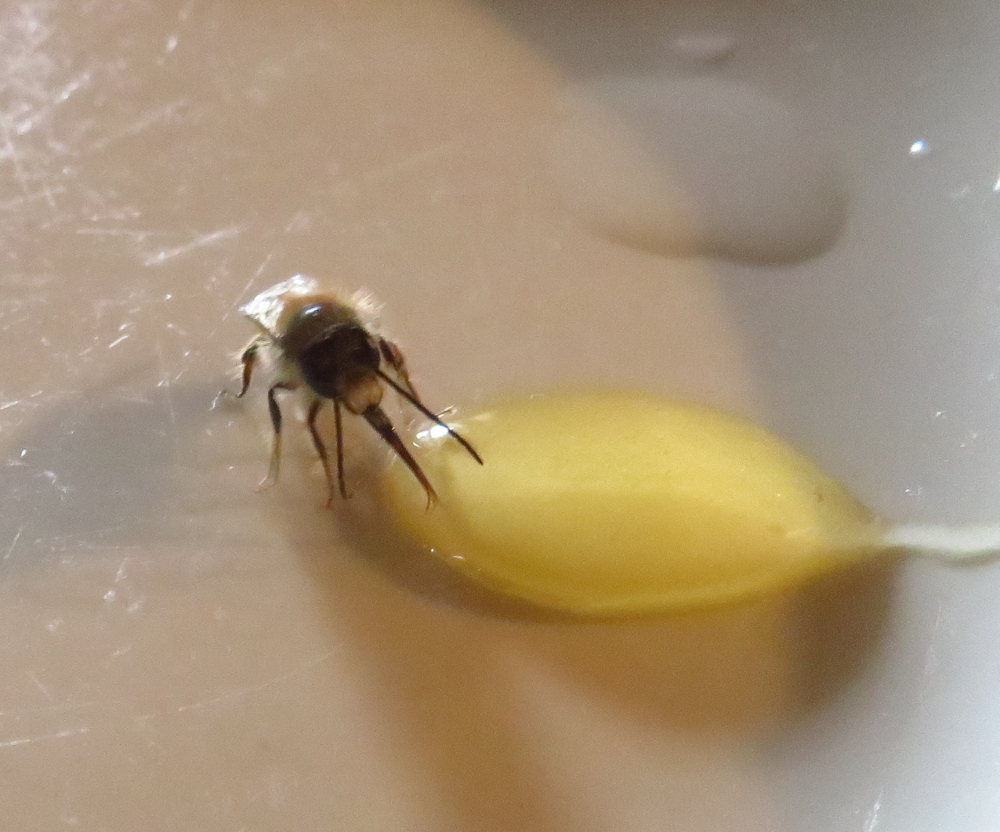
God formed those cool little bodies, fringed them with hairs, created the teardrop-shaped eyes, and designed those sweet little feet. Every part of them is designed by God, and shows how interested He is in them. He didn’t skimp on style just because they are small.
The artist in Beau took advantage of the fact that they were so still, and captured some photos. For me, seeing the face of an insect completely changes things. I know that the professional etymologists don’t like to call it a “face,” but I just call what I see. There is expression there, and an obvious response to us. When Beau moves close with the camera, the bee moves away or adopts a protective stance. There is give and take. And the little guys seemed so grateful for the warmth and food!

“A person’s a person, no matter how small,” Dr. Seuss said, in that old children’s book, Horten Hears a Who. I know that a bee isn’t a person, but it is a creature that God made, and therefore, it falls under the mantle of our responsibility as a human beings. We are stewards of God’s world, and caring for even the smallest creatures is part of that.
Besides, I felt responsible. If we accidentally dragged them into the warmth, then it was our fault. (Or maybe it was the 70 degrees midweek?)
But really, it’s so easy to help. We just had to learn the smallest bit about what they need, and then do what needs to be done. Capture, comfort, set free.
The next morning, I found an upside-down bowl on the table with a plate underneath, and two tiny bees inside. Tony had stayed up late, and left them there a few hours before. He covered them, so they wouldn’t be hurt or disappear into a window (or a lightbulb) and be dehydrated. A house is a dangerous place for an insect.
I lifted the bowl, and they didn’t seem to notice. They sat perfectly still.
“Oh no,” I thought. “They ran out of air.” For such things can happen.
I couldn’t see any movement, and so I gently blew some warm air on one. He instantly moved his antenna toward me, but remained still. I tried it with the other one, and he had a similar reaction. Whew! They were both still alive.
So what was the problem? Too cold?
I took them over to the pellet stove, hoping to slowly warm them up. Bingo. There was nothing slow about it. Within a couple of minutes, they were busy circling the plate, and I had to put the bowl back on to contain them.
Tony, as the resident amateur etymologist, decided that since they had refreshed themselves, they would be best suited in their natural environment. He figured that since they were ground-nesting bees, their instinct would be to find shelter under the ground, or under a pile of leaves, until it was warm enough.
So that’s what he did! He set them free on a warmish, sunny afternoon near blooming flowers and piles of leaves. It was still reasonably close to where we thought they came from, and we all hoped they would find their way back home.
God uses animals to teach us things, when we pay attention. I have found that animals-in-difficulty confront me with the imperfect parts of myself. Where I need to learn compassion, or patience, or to not fear and to trust God, those weaknesses become apparent when I am faced with an animal that needs help.
Why? Because no human being will hold me accountable for not caring for an insect. Or a rodent. So it’s tempting when I am in the middle of a project to just do the easy thing, the common thing, and brush it away. Kill it and throw it in the trash. After all, it’s my house, right?
But it feels wrong to abandon a little creature that I could possibly help. Even if only to preserve its life for one more day. Life isn’t more valuable because of its length, or because of how much money it can generate, or because of the value I place on it. It is valuable because only God can give life, whether it’s a small bee or you and me.
I am not putting all life in the same category. We do eat meat. That isn’t the point. We are all going to die. But while we are here, we can make things easier on each other by exercising compassion, kindness, gentleness, patience, and self-control. (Galatians 5:22-23) Those are fruits of the Spirit, and it’s so important to bear that fruit! It shows that we are the children of our Father.
“A righteous man regards the life of his beast: but the tender mercies of the wicked are cruel.” Proverbs 12:10
So by helping an animal (or even an insect, which is still part of the animal kingdom), I am rewarded with a lesson in character. And that lesson may help me when I am confronted by human beings with similar characteristics. . . .
Hmmm. It might be the way God designed it!
 The Fullers Four