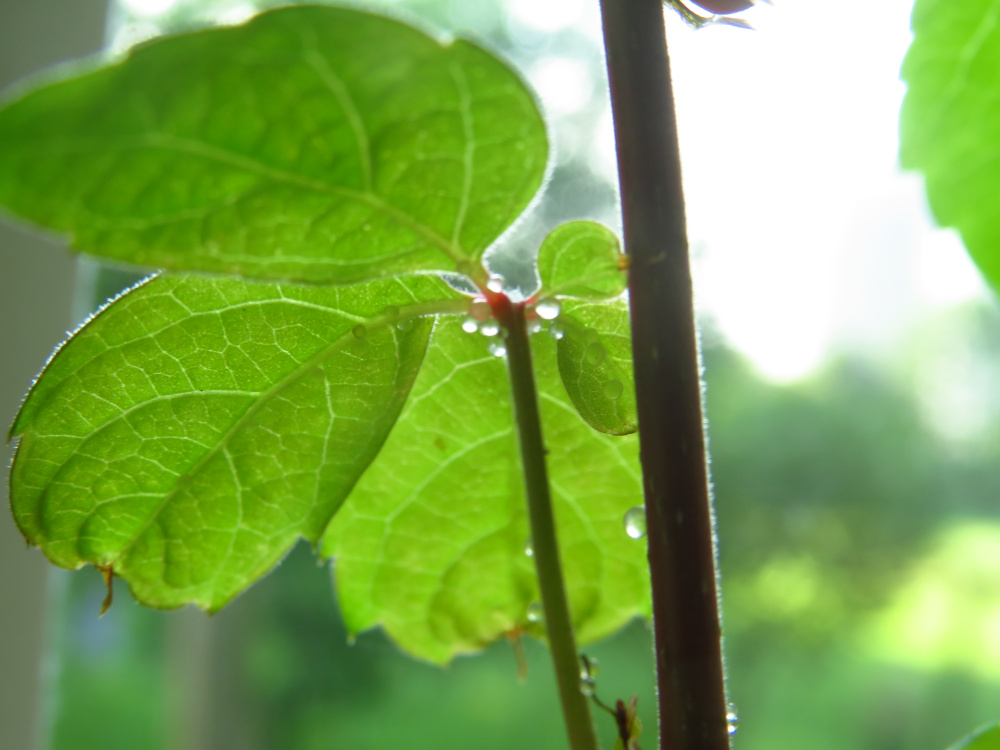
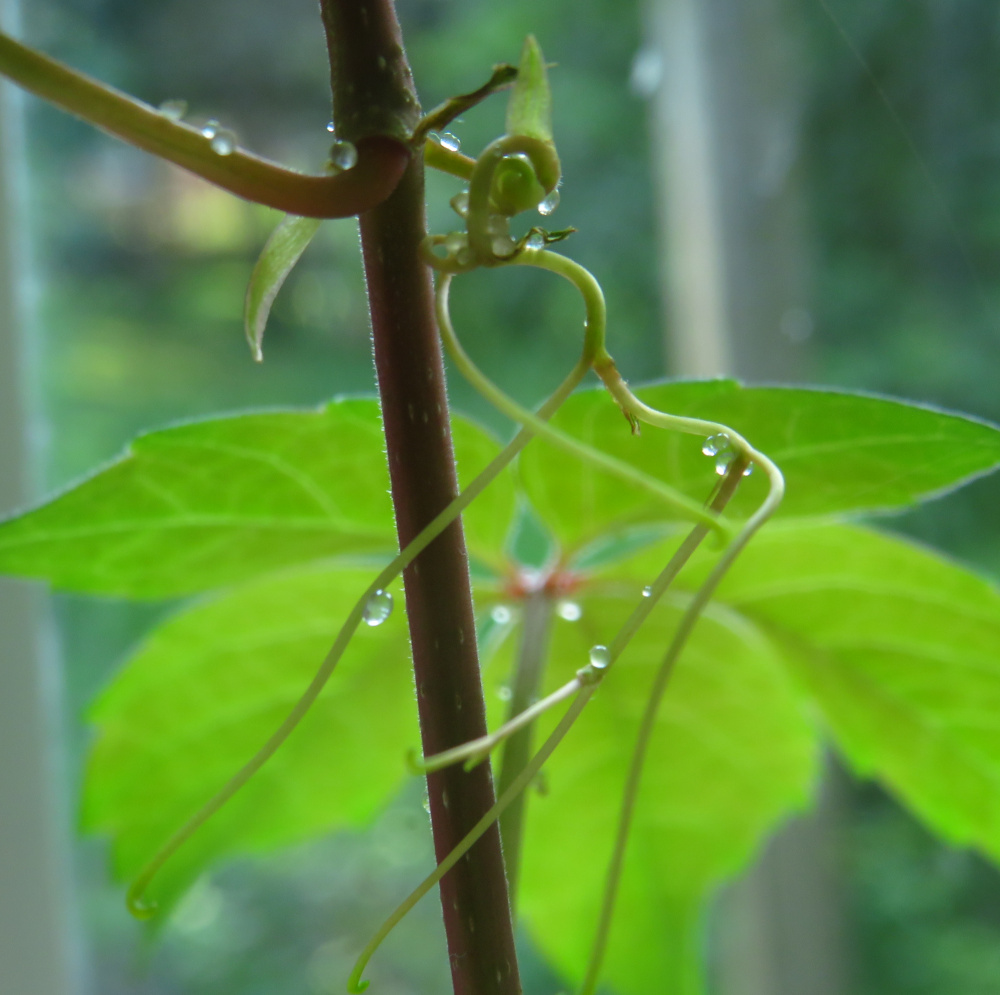
Yesterday was filled with seemingly disconnected events, that all ended up pointing to the same ideas. In the morning, I walked out into our back porch, and I noticed that a little six-spotted forester moth had been busy laying eggs on the Virginia Creeper. The tiny, translucent eggs were scattered along the stem and under the leaves, almost as if a dew, disobedient to gravity, had come. The little moth lays hundreds of eggs, never knowing what happens to them.
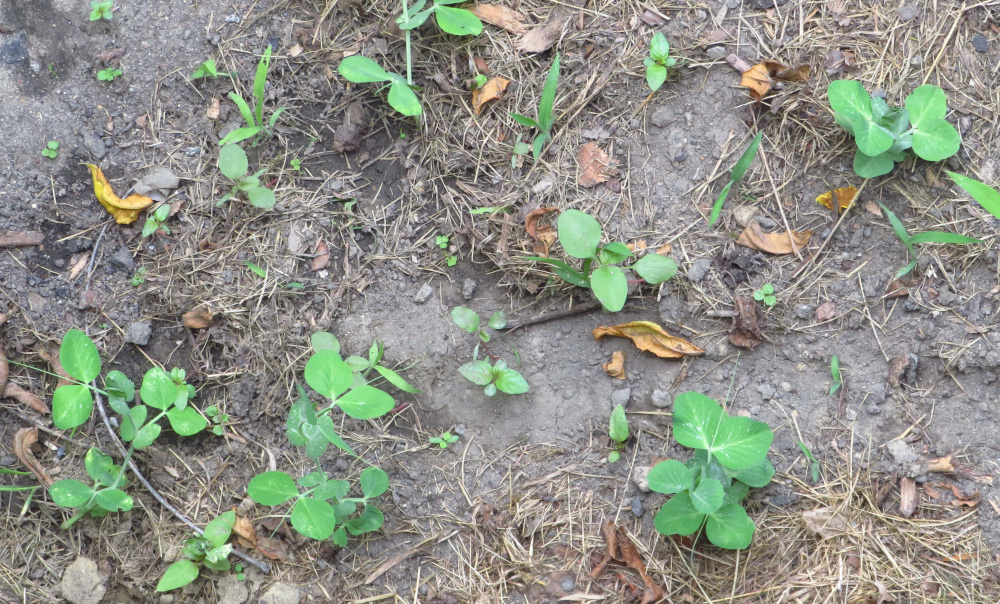
I walked outside and saw that the peas we had planted in rich soil (remember the snappy peas?) were finally beginning to grow, and I thought about the similarity between seeds and eggs, and how fragile they are. It’s amazing that life even has a chance to start with all of the challenges present.
But I got another surprise when I stepped into the yard! An amazing tomato plant, which seemed to appear out of nowhere, was sprawled next to the herb garden. Confused, because I know we hadn’t put any tomatoes in a place where they would compete with the grass, I began to realize that the tomato was growing along the ground in search of light. It stretched all the way back under the lilac bush, where we had tossed the leftover seedlings that we thought were too small.
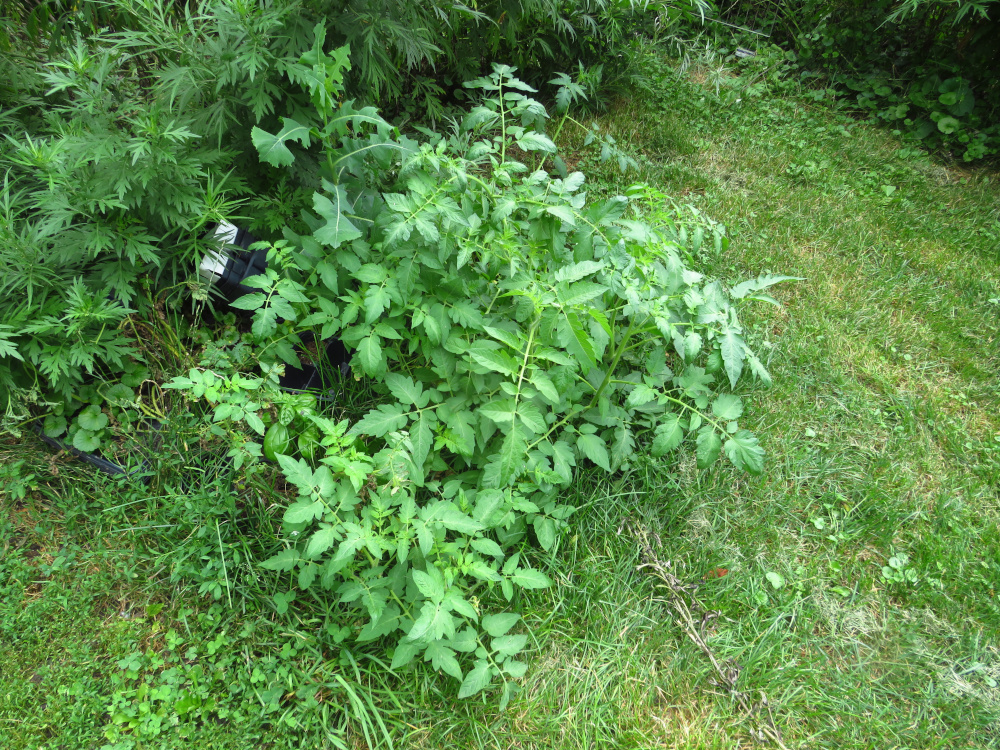
It was massive, especially considering its small footprint. It has flowers and is preparing to bear. I still haven’t figured out where the actual roots are (because I had to go back in and get ready for church), but it served as a lesson to me that we can never know for sure which little seed will thrive and which will struggle.
And then we went to a new church yesterday, to listen to a friend of ours who was guest preaching. The service started with a reading from the prophet Haggai, chapter 1, which was about how the children of Israel were carefully maintaining their own houses, but the house of the Lord was not yet built.
Ouch! Talk about misplaced priorities.
Our friend spoke on money and the need for the people of God to be generous, not just with money, but with all of the resources that God has gifted us. His text was 2 Corinthians 8, and Paul was telling the story of how the impoverished Macedonians, who desired to provide financial support for the Christians in Jerusalem, gave more than they could afford because they saw giving as a privilege. He was calling for the rich church in Corinth to follow the example of the poor Macedonians, and give.
As I listened, I felt myself having one “ah ha” moment after another. I had no bulletin, and nothing to take notes on, so I used a copy of a calendar that I had taken from the foyer, and began to use the blank spots to write down little nuggets of information so that I could remember later.
* Giving is a way to prove your love is real.
* God doesn’t want us to give what we don’t have, but only what we do have.
* The size of the gift doesn’t matter; God can use even a small gift to do great things.
* The way we use our money makes a statement about our values.
* Reconciliation with God leads to generosity; Jesus made himself poor so we could be rich.
These little nuggets were pieces that meant something to me, and may have not reflected the whole point of his sermon, but when I flipped the calendar to write on the other side, it struck me that the separations on the calendar (the lines that created the columns and rows), looked a little bit like the grid that cell packs make in a flat.
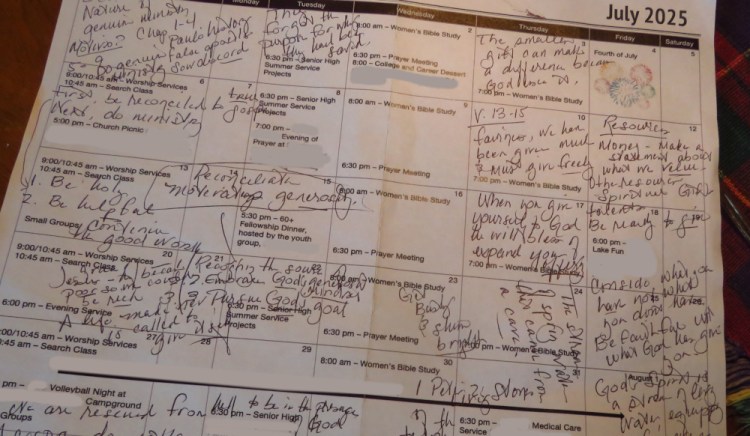
The little nuggets of wisdom in each square made me think of seeds being planted in each cell of the flat, and I wondered which “wisdom seeds” would grow and bear fruit. It would probably depend upon what the soil was like.
My gardener’s mind jumped to the image of what happens when I water a flat and miss a cell or two; the water usually pools on the surface of the cells that got too much, and that water will run off onto the one that didn’t get any. This is a visual image of how, when I receive more than I need, my excess should go to my neighbor, who is still without.
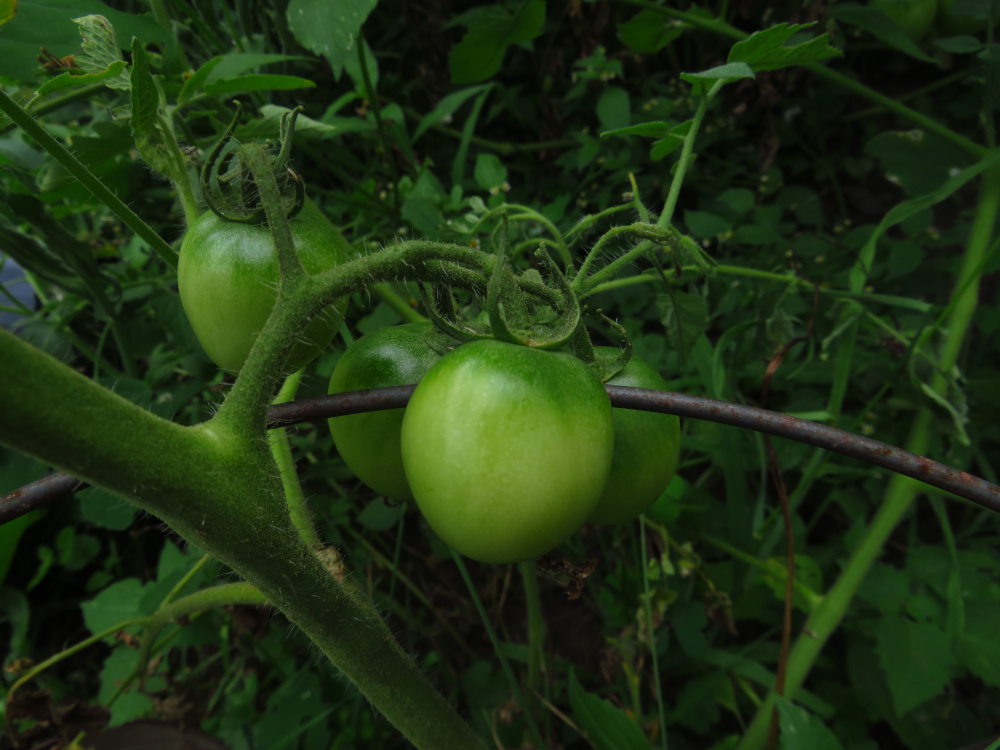
So I remembered the morning, and the plentiful eggs that had been laid on the leaves, and also the little patch of sprouted peas, seemingly so “rich” in resources, finally beginning to grow. And then I remembered the giant tomato plant that we gave up on weeks ago, that is still rooted in that tiny cell, preparing to bring us a harvest! (Maybe I should name that tomato plant, “Macedonia.”)
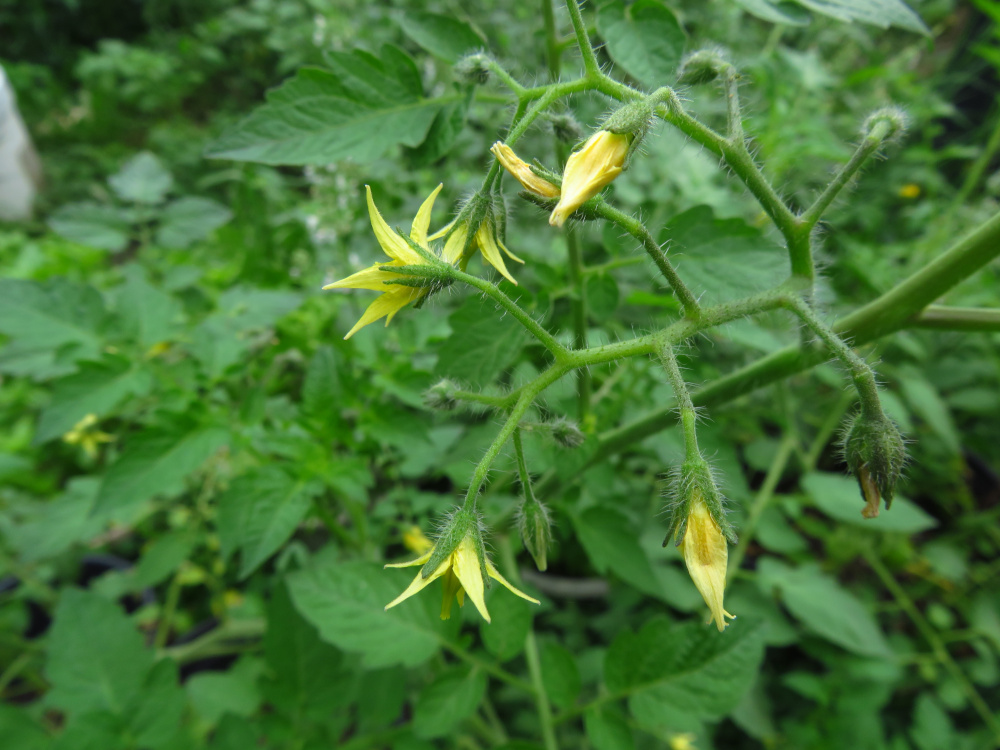
A flower is like a desire to bear fruit. The flowers feeds the bees, which then pollinate, and help create a harvest. The flower can’t bear fruit by itself. In like manner, when we get excited and start with what little we have, our passion draws those with more resources to get the job done. Passion is more precious than cash.
The sermon yesterday morning was straightforward: Be reconciled to God, and then you will be motivated and empowered to do good work for him. God will never ask you to do work which you are not equipped to do; He will richly supply your needs, and prepare you for the work to come. If we have plenty, we should share with our family and Christian friends who are in need first, and then with others around us. And keep in mind that our “plenty” may be lots of experience, or an ability to bake, or some other valuable skill. But God may ask us to do more than share from our overflow: God may ask us to give until it hurts.
I remember a time when God impressed on me that I should give a bag of walnuts to someone who asked me for them. At the time, it was a difficult ask, because I had no way to buy any more, and God had just sent them to me, as a gift from someone else. I had plans! But after I wrestled with it for a bit, I sent them off with joy because I knew God wanted me to do it. I reasoned that I must have been mistaken, and the walnuts must have come to me for the express purpose of blessing that other person.
And that is so true! Many times we are just the middleman, holding a blessing for someone else until the time is right for them to have it.
An amazing thing happened next: Over the course of the next week, person after person came to me and gave me walnuts. Not only walnuts, but all kinds of nuts. One man gave me Brazil and macadamia nuts. One woman brought me hazelnuts and almonds. During that first week, I accumulated a whole tote full of nuts!
God promises that we cannot out-give him. He doesn’t need the things that we give. Consider: If God created all things, couldn’t he could provide walnuts for someone? The goal is not to have the resources, but to train us to handle the resources. It all belongs to God anyway. He is giving us practice handling resources to train us for greater responsibility later on.
When God asks us to give something that is hard to let go, He is testing our loyalty to Him, and He is showing us the limits of our love for Him. (Are we just using God? Do we only love the gift, or are we in love with the Giver?) But keep in mind that He already knows our hearts, so He already knows the answer!
But we don’t always know ourselves. We may struggle when God asks us to give, and He knows it will be a struggle. He is training us to trust Him, and to rely on His resources instead of limiting ourselves to what we can provide for ourselves. As we train, we get a real chance to participate in what He wants to do in this world. And when we share in blessing others, we also get a reward.
Like the little moth this morning, we are to give freely, generously, never keeping track of what we get in return. In fact, Jesus said it’s better to give anonymously, so that God, Himself, can reward you. (Matthew 6:3-4)
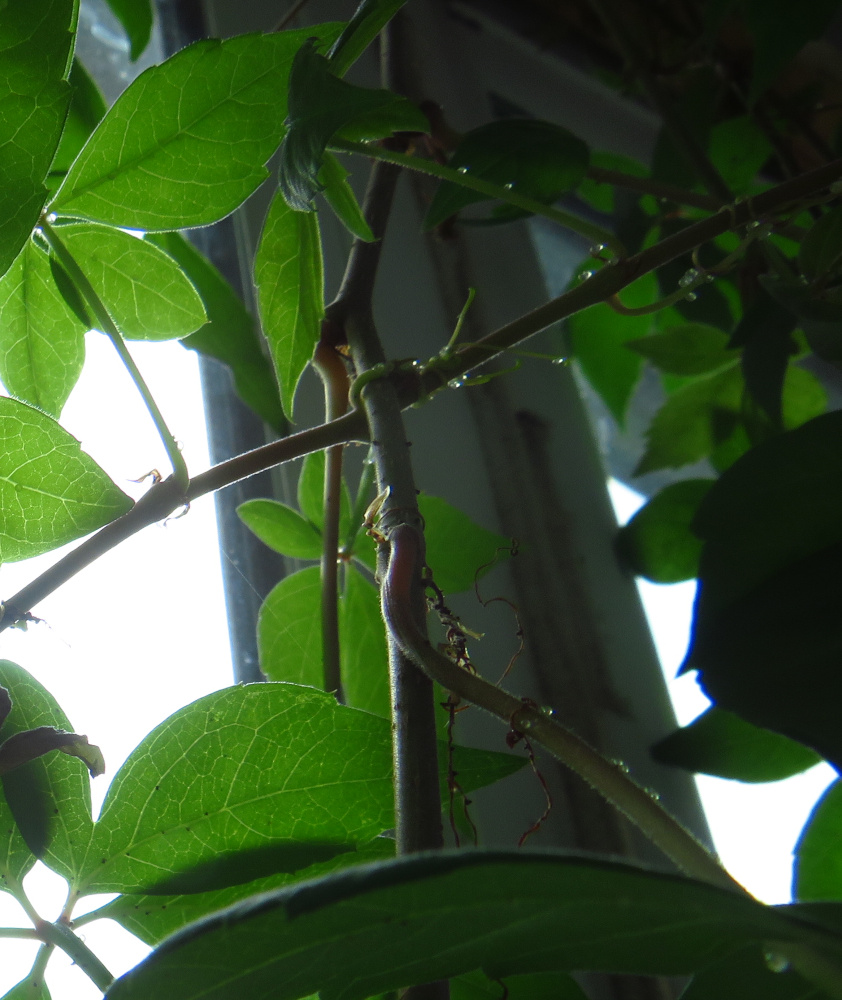
And like the little pea plants that had plenty of room, lots of nutrients, and a sheltered place to grow, yet didn’t produce much, we have to guard against enjoying our own prosperity so much that we don’t notice others. We miss the blessing of working with God when we do this, and forsake the treasures in heaven for our current comfort.
And lastly, we should never limit ourselves from giving because of our own poverty or lack. Each one of us has something to give, even if it’s only time. If we have a heart to give, God will provide the blessings so that we can bear fruit. Just look at what happened to the little tomato plant, root-bound in a tiny container: “Macedonia” didn’t let that stop him!
“God loves a cheerful giver,” Proverbs tell us, and the cheerfulness has to be real. Picture how much good the gift you are considering will do for the other person! In order to truly give cheerfully, we must align our hearts with God (be reconciled) and submit to His will in giving to others. And when we give, we must be prepared for Him to bless us, because He says that He will!
“Give and you will receive. Your gift will be returned to you in full measure; pressed down, shaken together to make room for more, and running over. Whatever measure you use in giving–large or small–it will be used to measure what is given back to you.” (Luke 6:38 NLT)
God bless you, my friends! Pray for us to be fruitful this week, and we will pray for everyone who reads this post to be fruitful, to multiply what God has given you, and to give with a cheerful heart!
 The Fullers Four