“My name is Patrick. I am a sinner, a simple country person, and the least of all believers.”
–St. Patrick, St Patrick’s Confession
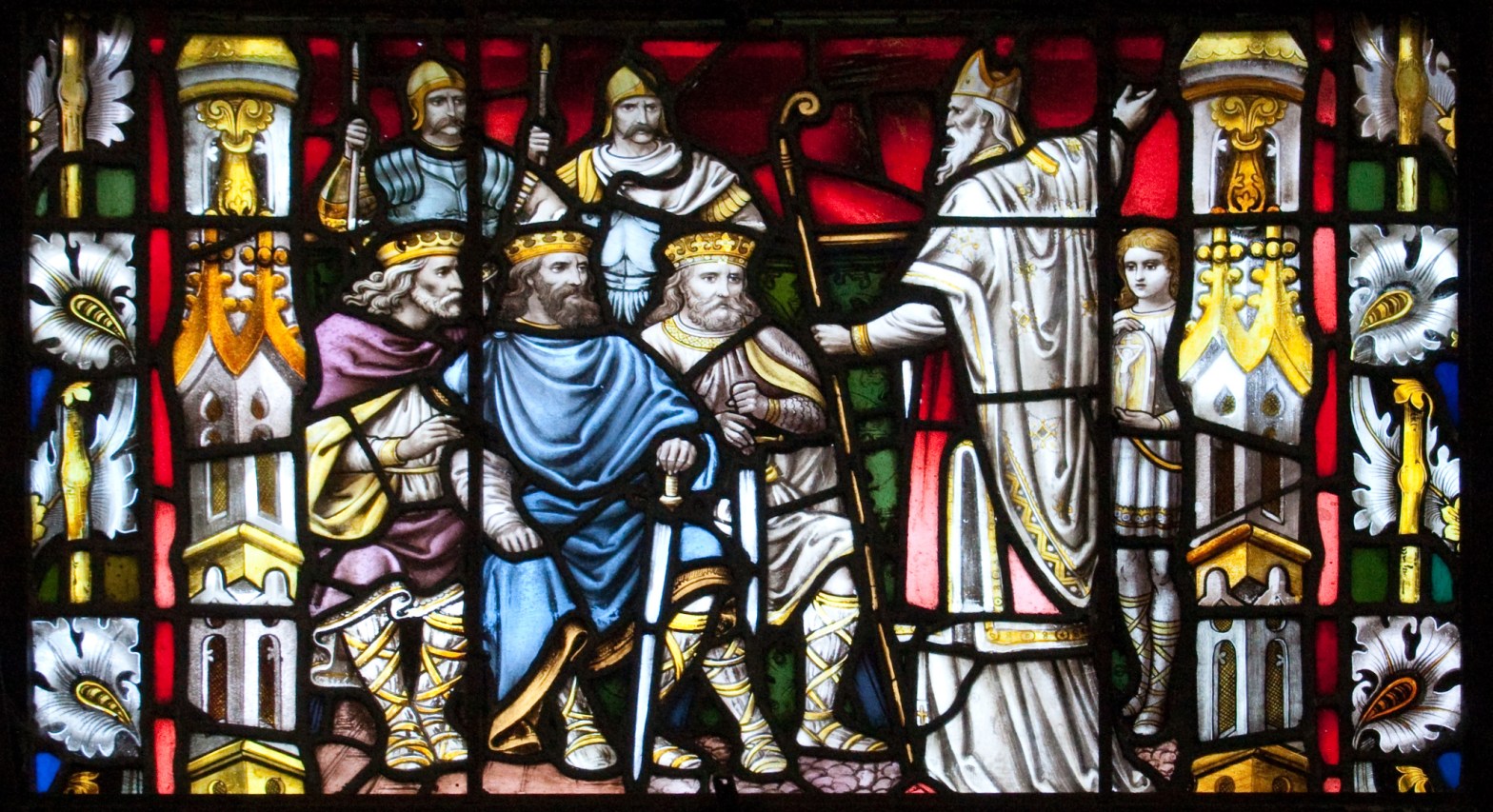
When I think of a Catholic saint, I imagine a stained glass window. The window above is what first drew me to the study of the life of St Patrick.
Who were the three kings? I wondered. I was intrigued to learn that St. Patrick was famous for his evangelism. My dad told me that St. Patrick drove all the snakes out of Ireland (real ones) and brought in Christianity. But I learned since that there were already Christians there, but they were few, and in need of encouragement.
There are several amazing miracles attributed to St. Patrick, though he did not explain many of them in his Confession, which he wrote near the end of his life, and which I read through in its entirety, today.
He was a humble person, ashamed of his lack of education and speaking ability. He wasn’t always a Catholic saint. In the beginning, he was just Patrick: a regular guy who resisted the Lord, then he suffered, and through his suffering, he recognized his dependence on God.
Just as it true for every one, God had a plan for Patrick, and it all began before he even knew God, when he was just a child. That was when Patrick was kidnapped by slave traders and taken to Ireland.
For six years, he herded animals, living outdoors most of the time, with hardly any clothing. These were the times most children would have been going to school, and so this became a severe handicap for Patrick. But God used the time of his slavery to bring Patrick to the place where he could see “how little I was,” as he phrased it.
As he lay all night on the side of the mountain, “the Spirit of God kept me from freezing,” he wrote. Ireland is a temperate place, with the summer temperatures hardly reaching 70. And in the winter, the average low temperatures reach the mid-thirties. So to be exposed to the elements, and all that wind, with very few clothes, for years, ugh! I shudder to think of it.
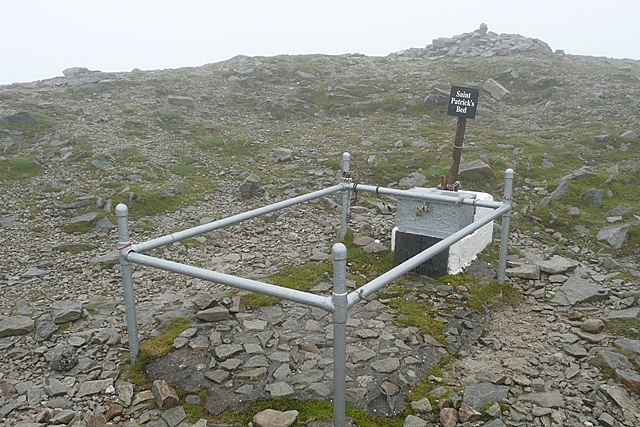
When I read St. Patrick’s Confession, I thought of the scene where Jill is blown off the mountain by the “beautifully warm” breath of Aslan, a Christ figure (from The Magician’s Nephew by C.S. Lewis). In my experience, God doesn’t do anything halfway. If He kept Patrick from freezing, I bet Patrick was WARM. And that is a miracle.
And so God became everything to Patrick. He said that he used to pray a hundred prayers daily, and almost as many at night. He was living what the Apostle Paul commanded, to “pray without ceasing.” Besides the sheep, God was his only companion during those long, lonely days, and their relationship grew.
After six years, God showed Patrick how to escape in a dream, and Patrick followed God’s instructions. He covered a distance of two hundred miles in order to get to a ship that was leaving for England. There is more, so much more to the story, but what I want to underline is that Patrick had few advantages in his life, except that God prepared the way for him.
And Patrick obeyed God. Patrick knew he was weak, and that he needed the Lord to strengthen him in many ways: In his ability, in his faith, and in his conscience.
When Patrick had completed his training in the church, he had a dream that a man named Victor was begging him to come back to Ireland to teach them about the Lord. In his mind, he heard the voices of those he knew during his time of slavery and realized that he needed to go back to help them.
Patrick was totally prepared for evangelizing the Irish. He knew the language, understood the customs, and had basically grown up there. He knew more than any missionary from Europe what would be the best way to approach the Irish people, and most of all, he loved them with a love that God had given him.
And in order to show the Irish people the truth about God, he knew he would have to perform signs and wonders. The people were used to seeing wonders from their druid priests, and so Patrick would have to do as well, or better, to challenge them.
And so, God empowered him. Soon after he arrived on the island, on the eve of Easter (of all times!), when all fires except the one kindled to honor a druid-god were prohibited, Patrick built a bonfire. And Patrick put his huge fire on the side of a hill, directly across from the pagan one.
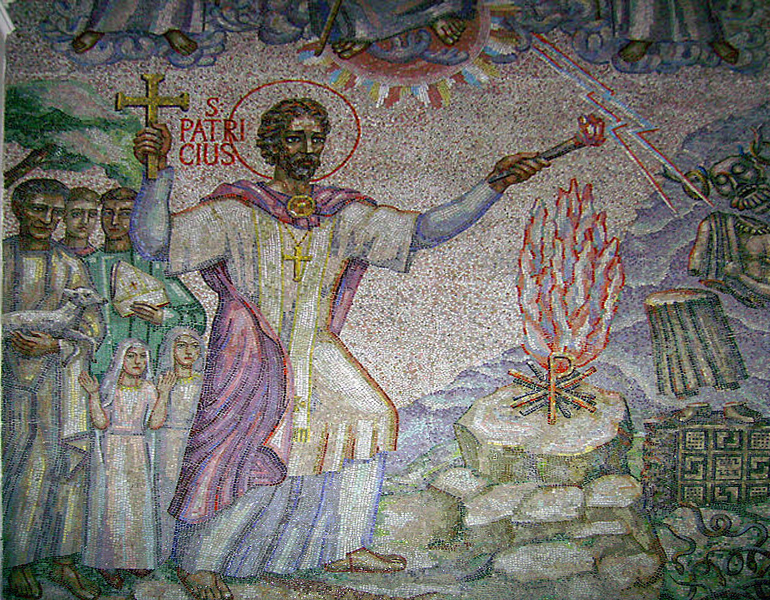
(Mosaic in Christ the King Cathedral, Mullingar, Ire./Wikimedia Commons).
As Patrick’s fire grew larger and larger, the King’s men came to put it out, but they couldn’t. It kept burning brightly all night, even as the other one died down and went out.
Patrick and his men didn’t run in fear. They were just standing there on the side of the hill. The king’s men had been commanded to kill them. But though the soldiers searched thoroughly, they could not find even one man. All they saw was a herd of deer.
Today, in addition to his Confession, we have a prayer-hymn that St Patrick wrote, that was preserved in the Irish Book of Armagh, called the “Lorica (Breastplate) of St. Patrick.” It was translated into English in 1889 by the wife of the Anglican Bishop of Londonderry, Ireland, Cecil Francis Alexander.
I mention the hymn because it is said to have been written by St. Patrick right before he confronted the King. Another title for the prayer is “The Deer’s Cry” or “Faed Fiada,” (because Patrick and his men appeared to be a herd of deer.)
“St. Patrick’s Breastplate” provides a little bit of a window into Patrick’s head as he prepared to this incredible showdown. In reading it, we get to watch Patrick suit up for the spiritual battle.
How would you prepare to go up against an earthly king who consorted with demons? Can you imagine what that must have been like for Patrick? There have been times when I helped Jim prepare for a spiritual battle, and our preparation consisted of strenuous prayer (which included the whole family), and the claiming of God’s promises found in scripture.
But Patrick came from a tradition which used written prayers, and more ritual readings. So he created a prayer of protection, and in it, he details all of the kinds of attacks from which he would like to be protected. He also states all the ways in which he receives power from God.
St. Patrick created a blueprint for us, so we can follow his reasoning, and echo his prayer. All of us can pray this prayer: We suffer the same attacks, and if we believe in Jesus, we also have the same source of protection.
I have found several versions of this hymn, and most shortened and simplified for the modern attention span. But I stumbled on a blog post by Sally Clarkson, in which she includes all 9 verses. (Titled “Bold and Wise, the Legacy of St. Patrick”, from March 17, 2010 on http://www.sallyclarkson.com.) In her church, she said, they sing all nine verses of St. Patrick’s hymn: Seven as the service starts, and the last two as a benediction.
Her version was the oldest I could find that didn’t leave anything out, and so I asked Tony to record it for us. I would like you to be able to hear it, perhaps listen more than once, to fully absorb the meaning. And he agreed to share it here. (You can also look up the beautiful hymn on your audio website of choice–or perhaps in your hymnal, called “I Bind Unto Myself Today.”)
Tony also agreed to put it into a little book, for those of us who have to see things to understand better (that’s me!). He also designed a cool bookmark using images from the beautiful stained glass window, above, with some of the prayer’s lyrics on the back. There is also a copy of the prayer on the page. All are free to download, and will continue to be available on our “Resources” page.
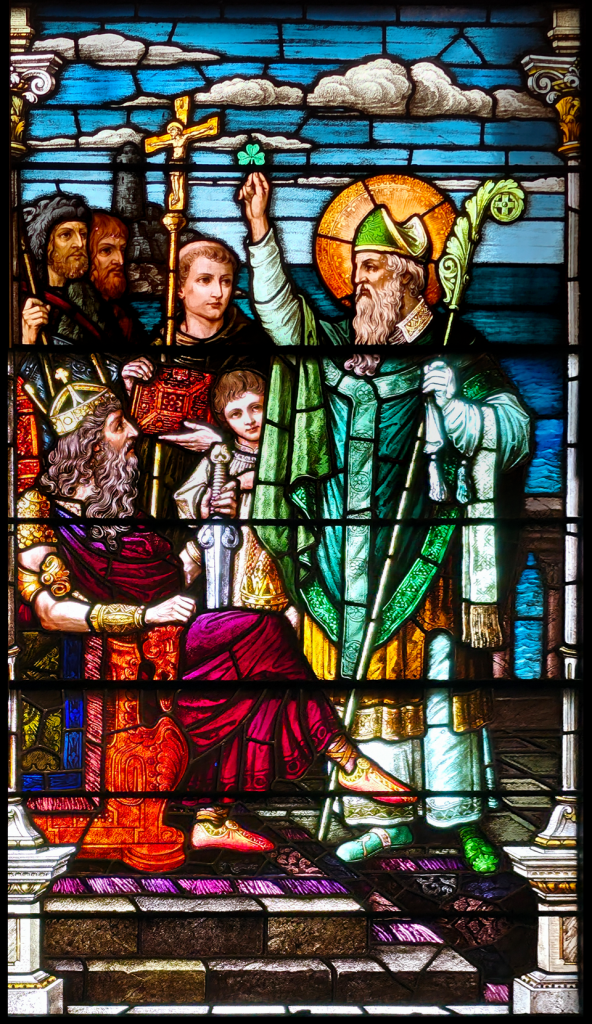
from Mary Immaculate at Lourdes Church,
(Zettler, Wikimedia Commons)
St. Patrick used the shamrock to explain the Trinity.
Patrick devoted his life to God, and desired to live out his days in Ireland, despite a longing to return to England to visit his family. He had been told by God that if he left, it would be disastrous for the people of Ireland, and because he loved the Irish people, he stayed for the rest of his life.
Like Patrick, may we all be willing to sacrifice everything for God! Our heavenly Father deserves no less, and Jesus said we are not worthy of Him if we aren’t willing to put Him first. Those words seem hard, but remember that every good thing comes from God in the first place. Jesus gave everything, up to and including his own life, for us. And He did it so we could be with Him.
“This is love, not that we loved God, but that He loved us, and sent His Son to be the atoning sacrifice for our sins.” (I John 4:10 NIV)
And when we are His, He will protect us. That is what this prayer is all about: It explains the power we have as children of God, and encourages us to take advantage of it. I pray the little helps we offer here will help remind you to “put on the full armor of God” each day, including the Breastplate!
May God bless and keep you, my friends!
 The Fullers Four