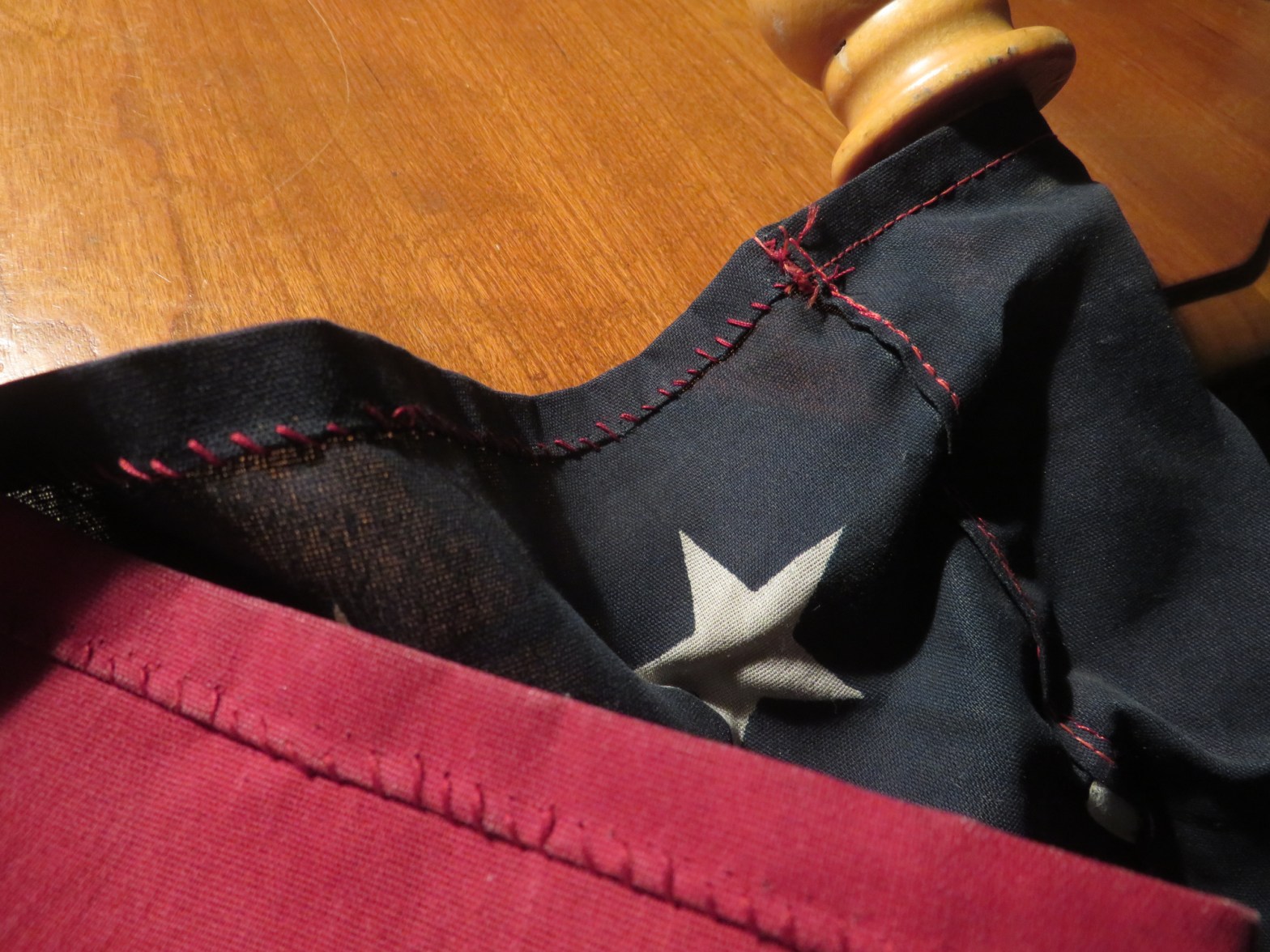
Each morning, someone in our house will raise the flag. And every evening, we bring her in before dark. She doesn’t touch the floor, or stay out in the rain. We treat the flag with respect, out of reverence for the men who have given their lives to fight for our liberty.
Both my father and my husband served in the military. There they learned the “flag rules.” And one of those rules is to never fly a tattered flag.
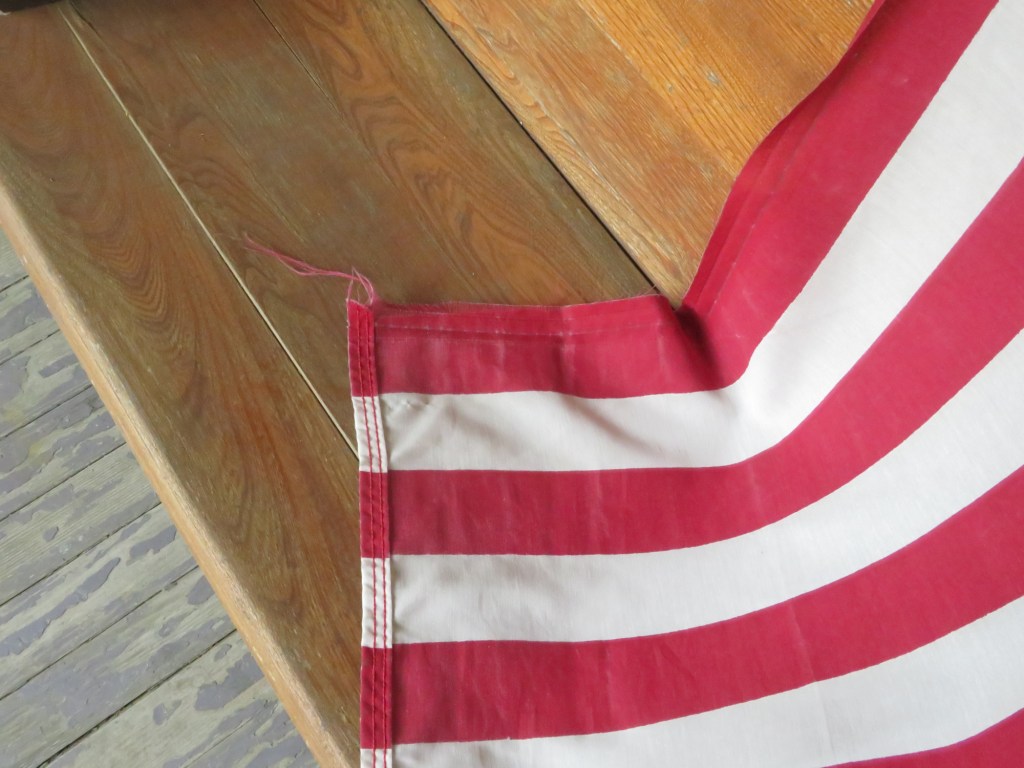
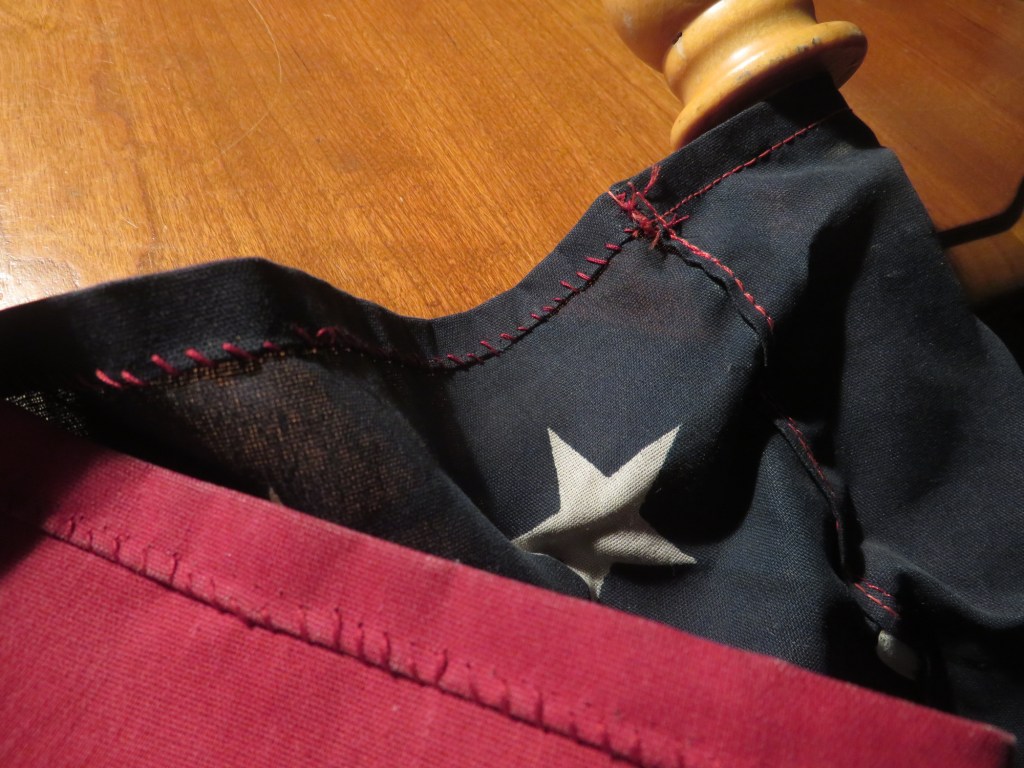
This morning, when my husband was about to raise the flag, he noticed a few strands of thread. On closer inspection, he realized that the seam had pulled loose along one side. He asked me if I could repair it. Of course, I said I would.
But it got me thinking about what the flag represents, and how the United States is in deep distress due to not only the economic insults and cultural challenges, but also because our role in the world is changing.
A seam let go along one side: Our flag is losing cohesion. And just like that old flag, our country is suffering from a lack of unity. Various entities have tried to inflame tensions in our “melting pot” so that we the people focus on each other’s differences instead of our common beliefs and allegiance.
Betsy Ross stitched together strips of red and white cloth, and sewed white fabric stars on a navy background. In the same way, separate colonies were stitched together to make a unified people, willing to fight together, back to back, for liberty.
Now, those Betsy Ross flags are hard to find. They have even been deemed a symbol of domestic terrorism by the FBI! How ironic. The symbol of our original unification as a country promotes terror? I bet the English deemed it a symbol of terrorism in 1776. But who now would consider a patriotic symbol of American unification a threat? Are they against us being unified, or against us remembering what brought us together in the first place?
Most American flags today have the design printed on a solid piece of cloth. But that is symbolic of our culture, too. For though we seem to be many states working cooperatively, we have an awful lot of commonality that would make it difficult for us to act as separate entities. For that to happen, it would be like trying to separate the white strips from the red on a printed flag.
So with these thoughts in my mind, I sat down to repair Old Glory. When I examined the corner that had a loose string, I realized that it must have been flapping that way for a little while. The raw edge had begun to shred. The question was how to repair the part that had gotten loose.
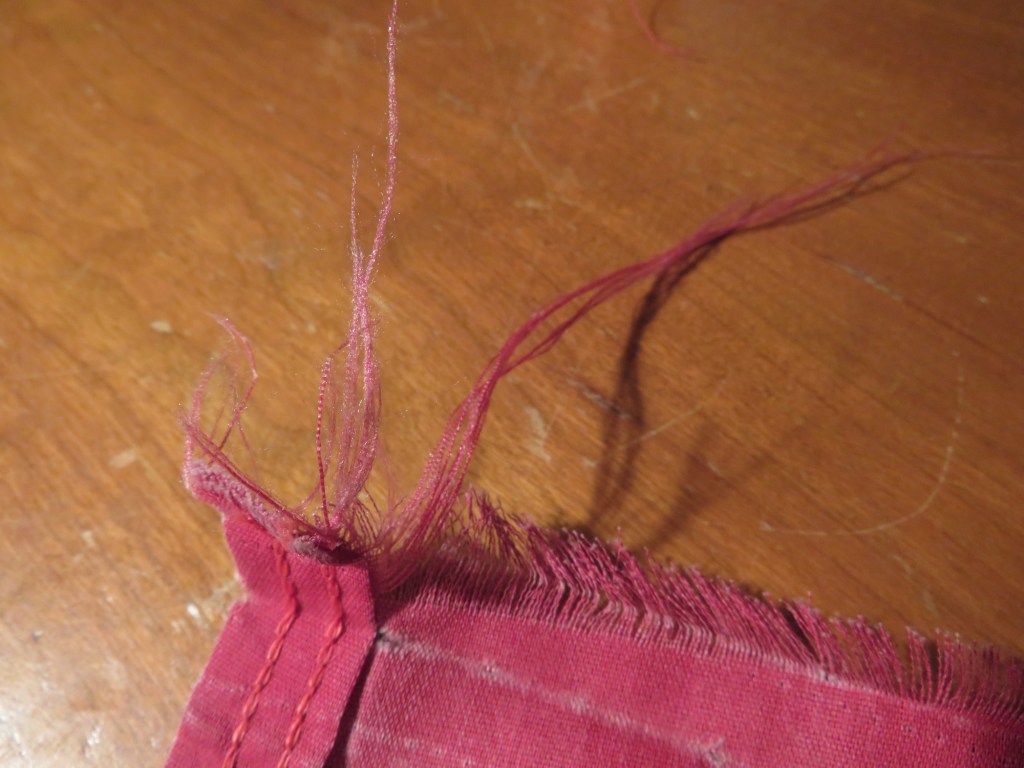
The first thing that had to be done was to trim away the parts that were no longer working. I cut the dangling threads and laid the ragged area out flat. It needed something to reinforce it so that I could turn it under and stitch up the seam.
I chose to use a piece of tape. That would hold the ragged part together so that I could turn it under neatly, and it would make a solid edge that I could hem. I taped it, folded it under and stitched up the hem along the one side. When it was finished, I checked my work.
It looked pretty good, but I was worried that the part with the tape would be too fragile to handle the constant whipping it would get at the very edge of the flag. So I went back over it, stitching a series of parallel lines, then reversing and stitching a perpendicular series of lines. It was like I was creating some new fabric in that one small spot. When I was done, it looked neat and felt strong.
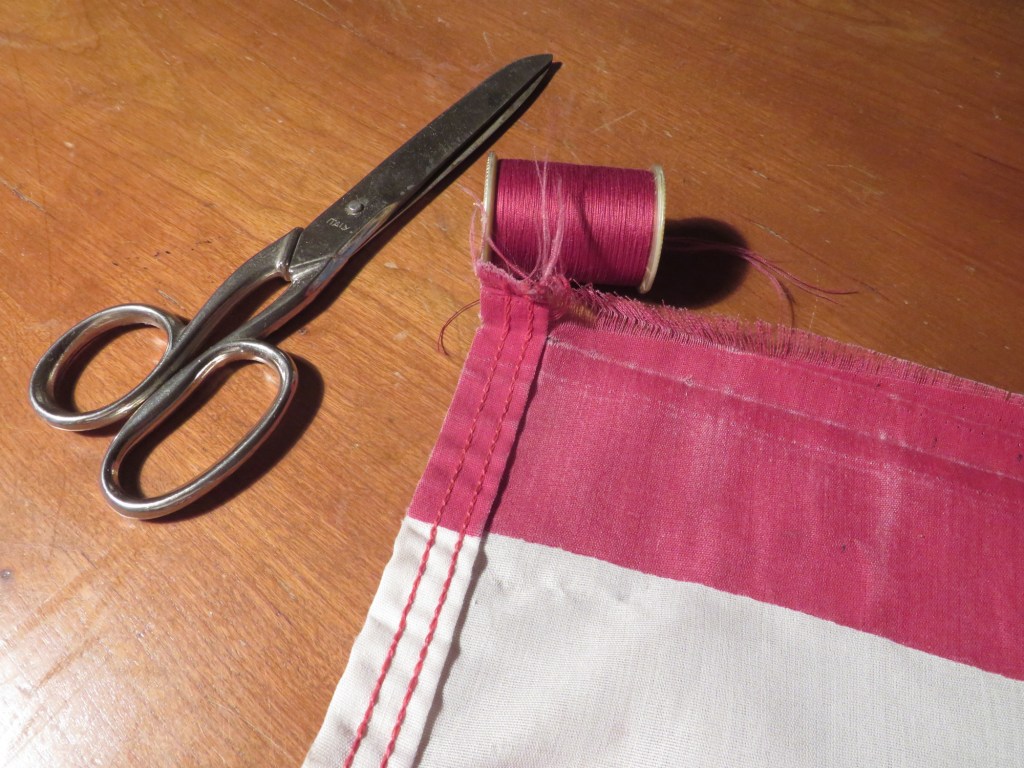
The thread held, not just the hem, but the fabric itself together. That red thread is what fixed our old US flag, but for the United States, what is the thread? It would probably be best to go back to the founding, and look at how we were constructed in the first place.
But don’t read a textbook, or a blog post for that. Read the constitution–it’s shorter than you think. Read George Washington’s letters. Read John Adams.
Why should we be united in these United States? Urging unity before the Declaration, Benjamin Franklin said, “We must all hang together or we will all hang separately.” And he was right that a unified United States would be better able to repel the superpower, England.
And after the war for our independence, why continue to stay together ? Was it because we could buy in bulk and get better pricing? No, better read the Federalist Papers, a collection of essays that our founders wrote to ague the reasons why the states in the union should remain united after the war for independence. (The Anti-Federalist Papers were written by the founders who didn’t want us to stay united.)
Our enemies are working to divide and conquer us, and as Abraham Lincoln said, “America will never be destroyed from the outside. If we falter and lose our freedoms, it will be because we destroyed ourselves.” (Would you like to know who our enemies are? Ask yourself who is actively working to cause division. )
It would take a long time to read all those original documents, just to find the reasons our founders thought we should stay connected, and time is of the essence.
Well, here’s a compromise: Alex de Tocqueville was a French researcher who came to America in 1831 to observe and report. He wrote a huge book on his observations called “Democracy in America.” Here are a few of his quotes about the early United States:
“The greatness of America lies not in being more enlightened than any other nation, but rather in her ability to repair her faults.”
It’s almost like he knew about the whole torn flag analogy, isn’t it?
“Liberty cannot be established without morality, nor morality without faith.”
Morality and faith are critical components for liberty, eh? How are we doing?
“When the past no longer illuminates the future, the spirit walks in darkness.”
Without history. . .darkness. And darkness, of course, is where democracy dies. Better read up.
“I know of no country in which there is so little independence of mind and real freedom of discussion as in America.”
Ouch. And keep in mind that this was in the early 1800’s.
“Grant me thirty years of equal division of inheritances and a free press, and I will provide you with a republic.”
Sounds like a free press is pretty important.
“The Americans combine the notions of religion and liberty so intimately in their minds, that it is impossible to make them conceive of one without the other.”
So he is reporting that the idea of religion was completely wound through the early American ideas about liberty. He was an eye-witness, by the way, which means he has more clout than a college professor.
So in keeping with the analogy, what is the thread that will repair America? Well, he has listed several strands wound into that thread: A free press, religion, independence of mind, a good grasp of history, morality and faith. He even defines the greatness of America as her ability to repair herself.
So the next question to ask is where has that thread failed? Has it failed all the way around? Even between the printed stripes?
Judge Mark Boonstra, third district of Michigan’s Court of Appeals has written a book, In Their Own Words. He did all that reading and studying of the primary documents and records that our founding fathers left behind, and consolidated it for us. I haven’t read it, but would like to at my earliest opportunity. If you would like to hear his report, you can find it here.
But don’t give up on US. We the People are just waking up from a very long nap.
 The Fullers Four